Showing posts with label database. Show all posts

Sunday, October 19, 2025

KLL Sketch Quantiles

Recently I was looking for a good way to "characterize" the values in a column of a database table, to help Suneido's query optimizer choose the best index to use. Originally I was thinking of some kind of histogram. While "discussing" alternatives with Gemini, KLL Quantile Sketches came up. Histograms are usually equi-width - each bin represents the same range of values e.g. 0 to 1 out of 10. Quantiles are usually equi-depth - each bin represents the same frequency of values e.g. 1%. With database data you don't usually know the range of values and it's not easy to divide values like strings into equal ranges so quantiles made more sense.

The name "KLL" comes from the authors (Karnin, Lang, and Liberty) of the original paper Optimal Quantile Approximation in Streams.

I have to admit I struggled with understanding KLL Sketches. At first I got Gemini to explain them to me and show me a sample implementation. I thought I understood it until I tried to implement it. Since I was off track, I quickly led Gemini astray and ended up flailing around for longer than I should have. I finally gave up on AI and went back to the original paper. The bulk of the paper is math theory proving that the algorithm worked within specific error bounds. I didn't realy follow the math and I didn't really care about the proof - I was willing to take their word for it. I just wanted to know how to implement it. In the end, the key part was a couple of paragraphs of the paper. The basic idea is pretty simple.

Unfortunately, I didn't find a lot of material on KLL sketches (or its precursor MRL sketches). There isn't even a Wikipedia page! There is an Apache DataSketches library that includes KLL sketches. I didn't look at their code. Trying to figure out basic ideas from a full implementation is hard.

It's easiest to understand by working through several increasingly optimized versions. The first version is just several buffers that hold k values. k determines the accuracy and a common value is 200 which gives 1.65% accuracy. The buffers are known as "compactors".

Incoming values are added to the first compactor. When it gets full, you sort the values, and then taking them in pairs of consecutive values you pick either the even or the odd ones and discard the others. Even or odd is chosen randomly, or randomly first time and alternating thereafter. You end up with half as many values, which you promote to the next compactor. In turn, when the next compactor fills up, you compact it and promote half the values. You add compactors as necessary. Each compactor represents/summarizes twice as many values i.e. its weight doubles.

The first optimization is that as you add levels, the levels closest to the input can be smaller without losing accuracy. The newer values are less important since they represent less of the data. This saves memory and reduces the work of compacting. The size factor is called c and the usual value is 2/3.

In terms of the algorithm, you add a new level of size k and shrink the existing levels. But in terms of implementation, you can't really shrink a memory allocation. You can take a sub-slice but the full size is still there behind the scenes. Instead, I added a new smaller compactor on the input end. The problem with that is that the pre-existing compactors now have the wrong weights. To fix that, I compact each of those previous levels in place, which has the effect of doubling their weight. This approach isn't in the original paper (which is light on implementation) but it seems to retain the correct behavior.

As the compactors get smaller, eventually you reach the minimum size of 2. The next optimization is that all the levels of size 2 can be combined into a "sampler" which randomly selects one value from every 2^n where n is the number of size 2 levels replaced by the sampler.

Querying the result is straightforward - you take the values with their implicit weights and sort them. Then the cumulative weight gives you the quantiles. e.g. 50% of the weight gives you the median.

There are further optimizations that I didn't implement. They seem more theoretical improvements than practical. My simple implementation (< 200 lines of Go) seems to give good performance with low memory requirements. (> 100,000,000 values/second, zero allocation once it reaches the maximum size of about 600 values)

Friday, January 12, 2024

Fuzzing - the gift that keeps on giving

It's been almost a year since I started fuzz testing Suneido database queries and it's still finding bugs. I assumed it would find bugs at first, and then peter out. But we set them up to run for an hour every night to catch any regressions and that has turned out to be very worthwhile. Of course, I'm sure I've fixed the last bug now :-)

I have a bunch of Go tests for the query code, and they have decent coverage. But they barely scratch the surface in terms of combinations of query operations. Passing these tests gives me little confidence that changes are correct.

We also have lots of application tests that do a lot of queries. But all the queries are written by humans and follow similar styles and approaches. The bugs found by fuzzing were not detected by the application tests. That's probably partly because I used those application tests to initially develop and debug the gSuneido query implementation. So those types of queries have been well tested and debugged.

It might seem obvious, but one thing the fuzz testing has hammered home is that making something work for "normal" cases can be quite different from making it work for every bizarre unreasonable case. I look at the failing queries from fuzzing and I think "no one would ever write a query like that". And yet, they are bugs nonetheless.

In most cases when the nightly fuzzing would find an error (a difference between the results from gSuneido and jSuneido) I could easily reproduce it. But occasionally it would depend on the randomly generated data. (e.g. that a certain value did or didn't exist) That could make it hard to reproduce the error to debug it. We tried saving the data from each run, but that was awkward. We ended up saving the seed for generating the random data. We could include that with the results and use it to recreate the data.

The data dependency made me realize that we weren't testing many sets of data, just one per night. Rather than generate more sets of data (slow relative to running queries) I changed the fuzzing to try several variations of the constant values in each query. That had a similar effect to trying different sets of data.

It wasn't entirely surprising, but it was interesting that the fuzzing didn't find any errors in the jSuneido query implementation. The fuzzing only detects differences between the implementations, it didn't tell me which was right and which was wrong. Several times I convinced myself that it was jSuneido that was wrong, but it always turned out to be gSuneido. The gSuneido query implementation started out very similar to jSuneido. But over the years it got refactored and improved and optimized. gSuneido's query optimization is now quite a bit more sophisticated, which means more complex, which means more bugs unfortunately. jSuneido has also been around longer so maybe that helped work out the bugs. It's also much more stable - I've barely touched the code for several years whereas the gSuneido code has been changing constantly.

Another aspect that was surprising was how "rare" some of these failing queries were. We are running about a million queries per night. I would have thought that would explore the possibilities fairly well. But some of the bugs were only caught once after weeks of running. In hindsight that shouldn't be surprising - there are an infinite number of possible queries, and when you add in the data dependencies, the failing cases are even more rare.

Like other fuzz testing systems, I accumulate the failing queries in a "corpus" and run them every time along with new random queries. Quite often these are the ones that fail again. They obviously are "tricky" queries as far as my query implementation goes.

One concern I had was whether my ad hoc random query generation would generate "all" the possible queries. There could be bugs that could not be "reached" by the possible range of queries I was generating. Obviously, I don't know if there are bugs it's missing. But judging by the bugs it has found, it seems to have quite good coverage. In theory it should probably be based on the query grammar (the reverse of parsing). I ended up using a random sequence of additions and substitutions. One of the challenges is to ensure that the query is still valid e.g. that the columns referenced actually exist in the sub-query.

When I get a failure, the first thing I try to do is simplify the query. Most of the time there are parts of the query that can be removed and it will still fail. It's a lot easier to debug if e.g. there is only one join in the query. This is a fairly mechanical process and could probably be automated. (More easily from the parse tree than from the query text.) But it only takes a few minutes to do manually so it's not worth the effort to automate. (As long as there aren't too many bugs!)

One issue with my current approach is that it depends on using jSuneido for comparison. But we have replaced jSuneido with gSuneido and we're not using it any more. It's also awkward to have to run two processes and compare the results. I decided to write a "simplest possible query implementation" within gSuneido. I procrastinated on this for a while because I thought it would be a lot of work. But it only took me a few hours. I have to remember that the complexity is not inherent in the operations, it's almost all from the optimization. It still uses the same parser, but that seems ok because that's not where the problems are. It doesn't use any of the normal query optimization or execution. And in a way it's better than using jSuneido since it's not at all the same approach. And it's easier to be sure the simple implementation is correct. The alternate implementation is quite slow and isn't suitable for large results but it's sufficient for the fuzzing. And to get around the slower speed, with it all being within one gSuneido process, it's easy to run multiple threads.

Sunday, September 10, 2023

A gSuneido Database Optimization

While working on the recent gSuneido database issue I had an idea for optimizing the transaction conflict checking code.

The current code kept a list of outstanding transactions and for each a list of tables and their reads and writes. To check a new read or write meant a linear search through all the transactions for other activity on that table. If the data was organized by table rather than by transaction, it would eliminate the linear search. An action on a "rare" table wouldn't have to look at so much data. Some tables would be common to many transactions, but still normally not all of them. And even in a situation where all the outstanding transactions included a particular table it wouldn't be any slower than before.

At a high level it was a small change, but I wasn't sure how it would fit with the code. I knew I'd still need to keep a list of transactions and the tables they had accessed. It turned out to be relatively straightforward to modify the code. (A few hours work.) One of the questions was where to embed data and where to use pointers to separately allocated data. Embedding tends to be faster, but embedding in maps or slices can use more memory because empty slots are larger.

Before starting the changes I wrote a Go benchmark so I could see what effect the changes had on performance. As usual, it was hard to know what a "typical" pattern of activity was. For this benchmark the new version was over twice as fast. That was a bigger difference than I'd expected. Sadly, but not surprisingly, the change made no difference to the speed of our application test suite. It doesn't do many concurrent transactions so it wouldn't benefit. However, the stress test I'd used to investigate the "too many outstanding transactions" issue did show big improvements. When I collected the same measurements as before and graphed them, it looked even better. Up to three threads it didn't make much difference but after that it was substantially better. And performance didn't drop off under load like it had before. (Or at least, not until much higher load.)

The conventional wisdom for optimization would be to profile the code and find the hot spots. That wouldn't have helped in this case. The impact of the data structure was spread over the code. Nor would profiling have given any insight into a better data structure. As I commonly find, what is required is to have good mental models of the problem, the code, the programming language, and the hardware. Then you need to find an approach that is a good fit between all of these. Of course, the hardware performance model is a moving target. These days it's mostly about cache misses and branch prediction.

I'm always happy to improve performance, especially by significant amounts. But in the back of my mind I can't help thinking I should have written it better the first time around. Of course, that doesn't make sense because you can't write the "perfect" version. There's always going to be room for improvement.

Saturday, September 02, 2023

A gSuneido Database Issue

We've been gradually converting our customers' servers from jSuneido to gSuneido. Recently we converted a larger customer and they started to get "too many outstanding transactions" errors. Unfortunately, we'd changed multiple things at once with this customer, so it wasn't immediately clear whether this issue was because of the switch to gSuneido, but I suspected it was.

I had set the limit in gSuneido to the same value as jSuneido - 200 outstanding transactions. "outstanding" in this case either means uncompleted in progress, or completed but overlapping with an uncompleted one.

It seemed a little counterintuitive. gSuneido is faster than jSuneido. So why should it run into this more? My theory is that because it's faster, more transactions get processed and if some of them are slow this will mean more overlapping transactions, even though they completed quickly.

One of my first thoughts was to look at optimizing the gSuneido code. But if my theory was right, this could actually make the problem worse rather than better.

We temporarily solved the problem by adding slight delays to code that was using a lot of transactions. (i.e. we throttled or rate limited them). This worked but it seemed a little ugly to slow it down all the time, just to avoid a problem that only occurred occasionally.

That led me to add throttling to gSuneido, but only when the outstanding transactions got high (e.g. 100). Throttling would prevent hitting the limit (200). I wrote a stress test and this did solve the problem. And it was better than adding delays in the application code. But the problem was that once it throttled, it got really slow. If you throttled enough to prevent hitting the limit e.g to 10 transactions per second, then 1000 transactions would go from maybe .1 seconds to 100 seconds - ouch! And because throttling slowed things down so much, it increased the chances of transactions hitting the 20 second time limit. The cure seemed worse than the disease, it won the battle but lost the war. (Sorry for the proverbs.)

I started to wonder what the right limit was. 200 was an arbitrary value. The reason to have a limit was to prevent it from "falling over" under heavy load. But at what point would that happen? So I removed the limit and tested under different loads.

threads time tran/sec conflicts max trans
1 2 sec 5000 100 70
2 2 sec 10000 150 110
3 3 sec 10000 200 150
4 4 sec 10000 200 180
5 4 sec 12500 200 200
6 5 sec 12000 300 230
8 8 sec 10000 300 270
10 10 sec 10000 300 300
16 20 sec 8000 400 450
20 30 sec 7000 500 490
30 50 sec 7000 600 580

I was quite happy with the results. Performance did drop off with more than 5 or 6 threads, but not that badly. The maximum outstanding got well above the old limit of 200, but that didn't seem to be a major problem. The number of transactions aborting due to conflicts increased with load, but that's expected with that much concurrent activity. To some extent it seemed to be self limiting. i.e. the load itself slowed things down and effectively did its own throttling.

Of course, this is completely dependent on what my test is doing. Is it "typical"? No, probably not. For starters, it's doing continuous activity on multiple transactions as fast as it can, with no other work. Real application code is not going to be doing that. Our applications never do 10,000 transactions per second for long periods. The test does result in shorter and longer transactions, but the longest are only around 1 second, whereas in production we do see transactions taking much longer and sometimes hitting the 20 second limit (usually as a result of external factors). And my workstation only has 8 cores / 16 threads, so it's not really 30 threads.

Out of curiosity, I removed the limit from jSuneido to see how it would perform. 10 threads took 15 seconds or about 50% slower. That wasn't bad. But roughly half the transactions (5000) failed due to conflicts. Ouch! That wasn't so good. Even with only one thread, roughly 10% (1000) conflicted. As opposed to 1% (100) with gSuneido. The usual method of dealing with conflicts is to retry, but that would just increase the load and make things worse.

So what is the correct limit for gSuneido? Or should there be no limit? Should it ever throttle, and if so, at what point? Honestly, I still don't know the answers to those questions. But it does appear the limit could be considerably higher e.g. 500 instead of 200, which would likely eliminate the problem, other than rare extreme cases.

Wednesday, January 04, 2023

Three Weeks for Three Tweaks

It started with reports of slow database queries. At first I didn't pay too much attention, after all, some queries are slow. We're dealing with quite large data (in a small business sense, not in Google terms) and customers are choosing what to select on and how to sort.

It progressed to the same query being slow sometimes and fast other times. That seemed a little more suspicious, but there were still a lot of factors that might have explained it.

Finally someone came up with a simple example where the same query, ran on the same data, was 1000 times slower when you ran it slightly differently. That was bad news for me, since it definitely meant there was a problem with the query optimization. Why was it picking such a slow strategy sometimes, when there was an obviously better strategy. Especially when it was such an extreme difference. The optimization shouldn't have to be very accurate when there is a 1000 times difference!

It didn't turn out to be a bug, the code was working as designed. It was just a particular scenario that wasn't handled well by the current design.

After 20 years, the easy improvements have been made and I'm into the realm of diminishing returns. I ended up needing to "tweak" three aspects of the code in order to fix the issue. And all three were required before I could see if it was going to work. TL;DR - it did solve the problem.

One way of looking at the issue was that the optimization was getting caught by a local minimum. It wasn't smart enough to use a sub-optimal strategy in one spot in order to allow a better strategy overall. (It doesn't explore every possible strategy, for a complex query that would be far to slow.)

None of the changes were difficult, but they were all somewhat invasive, requiring changes to all the query operations.

Background

In case you actually want to try to follow what I'm talking about, here's a little background on how Suneido implements queries.

A query like:

(table1 join table2) union table3

gets parsed into a tree like:

where the leaves are database tables and the other nodes are operations. Each node has one or more strategies for execution, plus some parameters like choice of index.

Optimization starts with calling the optimize method on the root operation (union in this case) which then calls optimize on each of its sub-queries.

Execution works similarly by calling the get method on the root operation, which then "pulls" data from its sub-queries.

Tweak #1

Lets say we have a query like:  

table1 join table2 where id=1

During optimization, query operations can ask their children for their estimated number of rows. In this case join would get the table size from table1 e.g. 1000 and one (1) from the where since it's selecting on a unique id. But that information isn't sufficient to estimate the fan-out of the join.

So the first change I made was to return the "population" count in addition to the row count. The where could return 1 for the result count and e.g. 10,000 for the population i.e. table2 size. This allows the join to estimate a more realistic fan-out of 1:10.

Tweak #2

The next problem is when a temporary index is required, there are two costs - the "fixed" cost of building the index, and the "variable" cost of reading from it. But until now these had been combined into a single "cost". Other operations usually have only a variable cost.

Continuing the example from Problem #1, now the join can estimate the fan-out is 1:10, it can estimate it's only going to read 10 records from table2. So the variable cost will be low, but we'll still incur the entire fixed cost. So in this case we want to minimize the fixed cost. But to do that, I needed to separate the cost into fixed and variable parts everywhere.

Tweak #3

The remaining problem was that join didn't have any way to tell the sub-query that only a small part of the result would be read. To address this, I added a "fraction" argument to allow queries to tell their sub-queries how much of the result they estimated they would read.

In the running example, 10 rows from 10,000 would be a fraction of .001 Where before it would choose a strategy with e.g. a fixed cost of 1000 and a variable cost of 1000 (total 2000) over one with a fixed cost of 0 and a variable cost of 5000 (total 5000). Now the 5000 be multiplied by .001 giving 5, which is obviously preferable to 2000.

This allowed the optimization to avoid the local minimum.

Conclusion

I'm not sure how common the problem scenario is. It was only because we ran into such an extreme case (1000 times slower) that I got motivated to investigate. Perhaps less extreme cases also occur and will be improved by these changes. As far as I can reason, the changes should not make any cases worse.

Wednesday, July 22, 2020

Immutable B-tree Redirects

Regular update-in-place B-trees suffer from write amplification. To update a single key you usually end up (re)writing a whole node. In addition, SSD storage also suffers from write amplification because it can't update in place, it has to write new copies to an erased block.

Immutable B-trees are worse. Not only do you have to write a whole node, you have to allocate new space for that node. Plus you need to update the tree path leading to that node, which means allocating and writing several more nodes. (This "path copying" is common in immutable persistent data structures.) This can make index file space grow excessively, and require more frequent compaction or garbage collection. (On the positive side the writing is sequential which is more efficient.)

I ran into this problem when I wrote the jSuneido immutable B-tree implementation. To reduce it to a manageable level, I ended up persisting indexes to disk periodically (once per minute) rather than after each transaction.This reduces both the write and space amplification.

There are various other approaches to reducing the amplification. For example, instead of writing out a copy of an entire node, you can write only the delta (differences). The downside is that to get the current version of the node, you need to read possibly multiple deltas plus the original node.

With the new version of the database that I'm working on for gSuneido, I took the same approach of periodically writing index updates. I knew from jSuneido that this approach was workable but it still bugged me. After all, the whole point of a new design was to make improvements.

To reduce memory allocation (and subsequent garbage collection) I use a hash map of "redirects" and defer path copying till writing to disk. An obvious approach is to write the redirects to disk instead of doing the path copying. But it seemed like that had the same problem as writing node deltas (redirects are really just a kind of delta) - they improve writing at the cost of slowing down reading.

My aha moment was when I realized that I already have those redirects in memory in a fast hash table for use during transactions. They would only need to be read from disk when the database starts up. The only additional cost would be larger redirect hash tables, but this has minimal affect on speed.

Of course, at some point too many redirects will accumulate and it makes sense to "flatten" them, i.e. rewrite the nodes and eliminate the redirects.

Thinking through the ramifications of this design (long runs are good for that), I realized that one of the tricky parts was going to be "flattening" the redirects. If all you store are the original and updated offsets for the redirect, then you'd need to search the whole B-tree to find the spot to update. My first thought was that I just needed to also store the node the redirection applied to. But that's not sufficient because you have to update its parents all the way up the tree. Obviously, to path copy, you need the path. But to store the offsets of all the nodes on the path from the root to the leaf would double or triple the size of the redirections. This would somewhat defeat the purpose given that we're storing the redirections to save space.
Instead of storing the path to each redirection, I ended up storing a separate set of tree nodes on the path to redirects. This is smaller because paths share a lot of tree nodes e.g. the root node is on every path. When traversing the tree to find nodes to flatten, only tree nodes in the set need to be followed.

I have this implemented and it seems to work well. I don't have a complete enough system to benchmark yet. It'll be interesting to see what overall impact it has.


Thursday, February 21, 2019

Partial Incremental Encoding

I have been thinking about how to improve Suneido's Btree implementation.

Btree's were initially designed for disk storage. But Suneido memory maps the indexes and generally Suneido database servers have enough memory that the indexes are resident. Would it make sense to use a different Btree design for in memory?

One possibility is to not store the keys in the Btree, since there's no extra disk access to access the data if it's in memory. That's more like how you'd design a normal in-memory data structure. And it makes the Btree nodes much smaller.
But memory is not flat these days, we have multiple levels of caches. And in relative terms, cache misses are almost as bad as disk accesses. So what we really want is to minimize cache misses.

So we have a design continuum. No keys makes the index small but will mean a lot of indirection and therefore cache misses. Entire keys means no indirection, but indexes are big.

My first thought was to compromise and store a small fixed portion of each key in the index. This keeps the index small, makes nodes fixed size, and reduces indirection.

billbi
billybi
erikaer
eriner
ermaer

But ordered keys usually have common prefixes, so storing the first few bytes does not discriminate very well.

To handle that we can use prefix compression (aka incremental encoding or front compression)

bill0, bill
billy4, y
erika0, erika
erin3, n
erma2, ma

Prefix compression means we have to linear scan each node (i.e. you can't do a binary search). But Btree nodes are reasonably small and linear is actually the optimal access pattern for memory caches.

We can combine these techniques by only including the minimum information to differentiate each key from its predecessor.

bill0, b
billy4, y
erika0, e
erin3, n
erma2, m

Interestingly, this looks a lot like a radix tree, branching on a single character.

This nicely handles both dense (e.g. sequential values) and sparse (widely separated) distributions of keys. However, it does have a worst case - when we go from a sparse key (small common prefix) to a dense key (large common prefix) (e.g. bill to billy or erika to erin) we need more information than we have in the index. One option is indirection to look at the actual data. That's ok if it's rare, but not so good if it's common.

If we give up the fixed length idea (which is not as important for linear scan anyway) then we can store the extra information necessary for this case (the missing prefix information)

bill0, b
billy4, illy
erika0, e
erin3, rin
erma2, m

With this, only one indirection is required at the end of each search to compare the key to the actual data.

In my test data I averaged less than 1.1 bytes per entry. (Although obviously it can be more, as in this example.)

To search, we iterate sequentially, maintaining the known prefix after each entry, and comparing that to what you're looking for. Because we only have partial information, we may search one entry too far. e.g. if we're looking for "earl" we should stop at "erika", but since all we have for "erika" is "e", we'll look one past.

keyentryknown
bill0, bb
billy4, illybilly
erika0, ee
erin3, rinerin
erma2, merm

Inserting and deleting affect the encoding of the following values so you need to re-encode entries until you're back in sync. (e.g. hit a 0 entry) This requires looking at the actual data, but it's only for updates, and typically not that many entries.

I've prototyped the design and it seems to perform reasonably but I haven't implemented enough to actually benchmark it against Suneido's current implementation (which stores entire uncompressed keys).

Part of what triggered this was Design continuums and the path toward self-designing key-value stores that know and learn 

Tuesday, May 19, 2015

Stonebraker on Databases

I recently listened to a podcast on Software Engineering Radio with database expert Michael Stonebraker. (at the recommendation of a friend - thanks Larry) It's a few years old, but still quite relevant.

As usual, I relate much of what I read and hear about to Suneido. In this case it was interesting to see how Suneido's database held up to Stonebraker's criticism of current conventional relational databases.

He talks about profiling a database and finding that 90% of the time was spent on "overhead". The time consisted of four main areas:

buffer pool management
Keeping a cache of database pages, page replacement tracking, and converting from external (disk) record format to internal (in-memory) format. Since most transactional (OLTP) databases now fit in main memory, this work is even more wasteful.

record locking
Most conventional relational databases use pessimistic row level read and write locks to ensure that transactions are atomic, consistent, and isolated (i.e. ACID). Managing locks and waiting to acquire locks can be slow.

thread locking
Most databases are multi-threaded which, in most cases, means they use locking to protect shared data structures. Locking limits parallelism.

crash recovery write-ahead logs
For durability (the last part of ACID) databases commonly use a write-ahead log where changes are written (and in theory flushed to disk) prior to updating the actual database. In case of a crash, the log can be used for recovery. But writing the log is slow.

So how does Suneido do in these areas?

Instead of a buffer pool, the database is memory mapped. This handles databases that fit into memory as well as ones that don't. When they don't the page replacement is handled by the operating system which is in a good position to do this efficiently. Modern operating systems and hardware already have so many layers of caching and buffering that it seems crazy to add yet another layer of your own!

Suneido also does as much work as possible using the external format of records, only converting to internal format when necessary. For example, most database "wheres" are done in external format. The encoding of values into external format maintains ordering, so sorting can also be done while still in external format.

Rather than pessimistic record locking, Suneido uses optimistic multi-version concurrency control in conjunction with an append-only "immutable" database. This means that read transactions do not require any locking and do not interact with update transactions. Write transactions only require locking for the actual commit.

Suneido's database server  is multi-threaded with requests handled by a pool of threads. But most of the internal data is in immutable persistent data structures, which require minimal locking. And the database itself is an immutable persistent data structure requiring minimal locking. (I minimized the locking as much to avoid bugs as for performance.)

Finally, Suneido doesn't use a write-ahead log. Instead, its immutable append-only design makes it a type of log structured database, where the database itself can act as the log.

NOTE: This is based on the newer Java implementation of Suneido which has a different database engine than the older C++ version.

I haven't benchmarked Suneido's database against other systems so I can't make any claims about speed. But in terms of avoiding most of the overheads that Stonebraker identifies, Suneido seems to hold up pretty well.

Wednesday, March 26, 2014

B-tree Range Estimation

One of the trickier issues to deal with in Suneido is when the database query optimizer picks what seems like a poor strategy. One of the difficulties is that these issues are usually data dependant - so you need to do the debugging on a large database.

Suneido's query optimizer is fairly straightforward, but even on relatively simple queries there are a lot of possible strategies and it can be quite hard to understand the end results.

We had an issue recently with jSuneido where the sort could be satisfied by an index, but the strategy it chose was reading by a different index and then sorting (with a temporary index).

It wasn't hard to discover that it thought reading by the other index was enough faster to justify the temporary index. The problem was it was wrong.

It came down to the the btree range estimation. It was estimating the same key range quite differently for the two indexes, where they should have been exactly the same.

One of the important choices in query optimization is which indexes to use. To help with this, Suneido uses the index B-trees to estimate how "selective" a given range of index keys is, i.e. what fraction of the records does a range include. Because the query optimizer looks at lots of possible strategies (combinatorial explosion) you want this estimation to be fast. You don't want to read the entire index.

Strangely, I used the identical approach on both cSuneido and jSuneido, but they ended up choosing different strategies for the same data.

The code was doing a lookup on the "from" and "to" keys, estimating the position of the key from the path down the tree. Because a single path down the tree only looks at a few nodes out of a potentially large number, it has to assume that the rest of the tree is balanced and node sizes are "average".

It didn't take long to discover a rather blatent bug in both jSuneido and cSuneido. I was averaging the node sizes of the "from" search and the "to" search in order to get a better idea of the average node size on each level. But I wasn't adjusting the position within the node. For example, if the "from" search went through position 5 of a node of size 10, and the "to" search went through position 25 of a node of size 30, when I average the node sizes it now thought the "to" search went through position 25 of a node of size 20 - obviously wrong. On the positive side, if the node sizes don't vary too much then it doesn't have a big affect.

One reason why this bug hadn't surfaced yet is that the exact estimates aren't that important since the optimizer is just comparing whether different indexes are better or worse, not what the absolute numbers are.

That bug was easy enough to fix, and I came up with a much simpler way to write the code, but I still wasn't getting very accurate results. I started running the numbers through a spreadsheet to try to see what was wrong with my calculations.

After banging my head against the wall for a long time I finally realized that the problem was that the trees were actually not very balanced. A B-tree only guarantees that the tree is balanced in terms of height i.e. all the branches are the same length. It does not guarantee that each branch of the tree leads to the same number of keys. Most B-tree allow nodes to vary between half empty and full. When a node gets full it is split into two half full nodes.

However, if you add keys in order, this leads to most nodes only being half full. So Suneido uses a common optimization to split unevenly if a node gets full by adding on the end. In the "worst" case (in terms of balance) this leads to the root of the tree having a left branch that is full, and a right branch that has a single key. That is exactly what my data looked like in the "bad" case, but I hadn't realized the significance.

Side note - this optimization applies more to B-trees that use fixed node sizes, like cSuneido. jSuneido's append-only database uses variable sized nodes, so space wastage isn't an issue. However, you still want to keep the branching high to minimize the height of the tree.

My solution was for the estimation code to look at the sizes of all the nodes on the first and second level of the tree (root and one level below), rather than assume they were all the same average size. This doesn't handle the tree being unbalanced below there, but the lower levels of the tree have less of an effect on the final result. Finally I got some results that were at least in the right ballpark, and good enough so that jSuneido now chooses the "correct" strategy.

Maybe I've been spoiled by Java, but the unsafe nature of C++ scares me. I made a stupid bug in the cSuneido changes that wrote one past the end of an array. This passed all the unit tests, but gave some strange random errors later on. In this case it wasn't hard to find the problem, but it makes me wonder.

As usual the code is in version control on SourceForge.

Saturday, August 18, 2012

Btree Range Estimation

Suneido's database query optimization needs to select which indexes to use. Part of this is estimating what portion of a table is spanned by a given range of index keys.

My assumption in the past was that a crude approximation was sufficient, since usually the best index is obvious. So the estimation would only look at one or two of the top levels of the btree.

But recently, as a result of some performance work on our applications, we've found a number of cases where this isn't true, where you need a more accurate estimate in order to choose the best index. This is usually with large tables, e.g. millions of records. With big tables like this, only looking at the top one or two levels of the tree is not sufficient to differentiate e.g. an index range of a few records versus an index range of thousands of records. In this situation, the "wrong" choice can make quite a difference to performance.

One of the sources of inaccuracy is from estimating the size of a Btree level. So my first idea to make it more accurate was to look at all the nodes on each of the top levels in order to get an exact count. I implemented this, and it was an improvement, but the downside was that it could end up reading a lot of nodes because Btrees have a large fan-out.

So I went back to my old approach of doing searches for the beginning and ending values of the range, and estimated the level sizes and therefore the portion of the tree between them. I made a better estimate of the level size by basing it on the size of the nodes passed through on the search. Since this approach only does two searches down the tree (not reading whole levels) it's reasonable to go further down the tree to get a more accurate estimate. In the end, I found some cases required searching all the way down the tree to the leaves. This is ok, since Btrees are shallow due to their large fanout. (Even going all the way to the leaves is still not 100% accurate because you're still only approximating the level sizes on the way down.)

This was better, but there was still an annoying flaw - because node sizes vary, if a search happened to pass through smaller nodes, it would estimate different level sizes than a search that happened to pass through larger nodes. Different level size estimates would result in poorer estimates. Differences in level size estimates near the top of the tree were especially bad since their effect was multiplied. For small ranges (e.g. "close" values) this wasn't a problem because the two searches would pass through the same nodes at the top levels of the tree and therefore estimate the same level sizes. But larger ranges could be less accurate.

The improvement I came up with was to use the average of the search's estimates of level sizes. Not only does this give a better estimate, but it also means that the two searches use consistent level size estimates, which is just as important as the estimates being accurate. It was a little more awkward for coding since the averaging had to be done in the middle of the searches. I originally wrote the code as recursive, but ended up with an iterative approach since it was shorter and simpler. (Not because it might be faster.)

This may be a known technique, but I haven't encountered it so I thought I'd share it. If anyone is aware of better approaches, let me know.

jSuneido btree source (scroll to the end for the rangefrac methods)

Saturday, June 23, 2012

Immudb in Production

We took the plunge and converted our (Axon's) in-house accounting and CRM system over to the new version of jSuneido with the immudb append-only storage engine. We have about 50 users so it's a decent test, although we're not as heavy users as some of our customers.

So far so good, it's been running for a couple of days with no glitches.

We'll give it a little longer and then look at converting actual customers.

Wednesday, May 23, 2012

IllegalMonitorStateException and Stack Overflow

Just when I thought immudb was ready to deploy, I got sporadic IllegalMonitorStateException's.

I wasn't sure what that exception meant, but it sounded like concurrency, and that was not good news.

According to the documentation it comes from wait and notify. The catch is that my code doesn't directly use wait and notify. So something that my code uses is in turn using wait and notify.

I tried to catch the exception in the debugger to see where it was coming from, but of course, it never happened when I ran inside the debugger :-(

I started looking around at the docs for concurrency classes that I use and found that ReentrantReadWriteLock WriteLock unlock can throw IllegalMonitorStateException "if the current thread does not hold this lock".

Ouch. My server is NOT thread-per-connection. It uses a thread pool to service requests. So the thread that handles the request that starts a transaction (and acquires the lock) may not be the same thread that handles the request that ends the transaction (and releases the lock).

Because I'm not testing with lots of connections, most of the time all the requests will be handled by the same thread and it will work. But once in a while an additional thread would be used AND would happen to be ending a transaction, and then I'd get this error.

And my concurrency test is equivalent to thread-per-connection so it doesn't run into the problem. That's a weakness in my test, and in this respect the bounded executor I was using before is more equivalent to the actual server.

Of course, I can't guarantee this is the only source of the error, but regardless, it was a bug I needed to fix.

I needed a read-write lock that allowed lock and unlock to be in different threads. I didn't need (or want) it to be reentrant (where the thread holding the lock can acquire it multiple times).

I searched on the web but couldn't find anything.

It looks like it could be written using AbstractQueuedSynchronizer but I'm afraid if I write it myself I'll make some subtle concurrency mistake. I could find various examples of using AbstractQueuedSynchronizer but not a ReadWriteLock.

I'm stumped so I decided to post a question on Stack Overflow. (After searching to make sure there wasn't an existing question.)

I've always been a fan of Stack Overflow. I'm not a heavy user, but I've asked and answered a few questions, and if it comes up in web searches I give it preference. But this time I got a little frustrated with the responses. No one wanted to answer the question - they just wanted to tell me what I was doing was wrong. That's a valid response to some questions, and I have to admit I hadn't really explained the context. I thought the question was specific enough to make the context unnecessary.

I kept clarifying the question and trying to convince the responders that I really did need what I was asking for. It was even more frustrating that people were voting for the responses that just told me I was wrong.

Of course, part of the frustration was that I started to doubt my own design decisions. Maybe I should just be using thread-per-connection - it would have avoided the current issue.

But in the end, Stack Overflow came through again - someone posted an answer that was exactly what I needed. Bizarrely, that answer didn't get as many votes, even though it was the "right" answer.

The answer was to use Semaphore. I hadn't even noticed this class because it's in java.util.concurrent, not in java.util.concurrent.locks where I was looking. I guess it's not a "lock" although it can be used as one.

And when I went to look at the source code for Semaphore, I found that it is implemented (at least in OpenJDK) with AbstractQueuedSynchronizer (which is in java.util.concurrent.locks)

It was simple to write my own read-write lock using Semaphore and everything seems to work fine. I wondered about performance but it seems to be roughly the same as before. I ran some tests and I didn't get any IllegalMonitorStateException's, but it was sporadic before, so that doesn't guarantee it's fixed.

AbstractQueuedSynchronizer has both "shared" and "exclusive" features which seem to map well to read-write locking. But Semaphore doesn't use the exclusive feature. It seems like you could write a read-write lock based on AbstractQueuedSynchronizer that would be a little "cleaner" than Semaphore. But for now at least, I'm happier using something like Semaphore that is tried and tested.

Sunday, May 20, 2012

More Immudb Results

The test that I was using to measure concurrency performance was using a bounded executor - code I'd found on the web, back when I knew Java even less than I do now. I decided that it was more complex than it needed to be and I rewrote it just using a number of worker threads. Surprisingly, that seemed to eliminate the drop in performance with more threads.

I also tested on my Windows machine which has a similar CPU but with an SSD (solid state drive) instead of a hard disk. Here are the results:

Now the performance seems to consistently level off as the number of client threads increase. That's less worrying than the performance dropping, but it's still a little puzzling. It still doesn't appear to be due to actual concurrency scaling issues like lock contention. Perhaps it's running into some other limit like storage or memory bandwidth?

Windows + SSD was roughly 2 times as fast as Mac + HD. I suspect that's mostly due to the SSD, although the OS and hardware could also play a part.

immudb also shows more improvement on SSD than the previous version. (blue to red versus orange to green) My guess would be that this is because immudb's large contiguous writes are optimal for SSD.

On both platforms, immudb is about 4 times as fast as the previous version.

Tuesday, May 15, 2012

Immudb Concurrent Performance Puzzle

One of the tests I hadn't run on immudb (my new append-only database engine for Suneido) was a concurrency test I'd used to debug the previous database engine.

Here are some rough results. As usual, this is not a scientific benchmark. The operations it's doing aren't necessarily representative, and I'm not running it long enough or enough times to get accurate figures. But it still gives me some information.

I'm pretty happy with the results relative to the previous version. Up to four client threads it's about four times as fast - can't complain about that. And another good result that's not shown by this chart is that immudb has a lot less transaction conflicts.

Also on the positive side, I only found a couple of bugs, and none of them took more than a few minutes to fix. This is a sharp contrast to when I was debugging the previous version. I give credit to the immutability and the resulting reduction in locking.

But I'm puzzled by the drop in performance over 4 threads. And I didn't even include 8 threads because the results were all over the place - anywhere from 3000 to 6000. There's some variation with less threads, but nowhere near this much.

If the performance just levelled off, that would be one thing, but I'm not happy with the performance dropping under heavy load - that's not what you want to see.

The previous version may not perform as well, but it doesn't show the puzzling drop off with more threads. Although, even with the drop, the immudb performance is still much better than the previous version.

At first I was only running 1, 2, 4, and 8 threads. My computer has 4 cores with hyper-threading for more or less 8 hardware threads so I thought maybe it was because I was using up all the hardware threads and not leaving any for other things like garbage collection and the OS. But that wouldn't explain the drop off at 5 threads.

I looked at hprof output, but it didn't give me any clues. It did highlight some areas that I could probably improve, but not related to concurrency. (they were related to one of my pet peeves - ByteBuffer)

More threads could mean more memory usage, but JConsole and VisualVM don't show a lot of time in garbage collection.

The obvious issue is some kind of contention. Immudb doesn't do much locking (because most things are immutable) but I could see contention over the commit lock. But JConsole and VisualVM  don't show much waiting for locks. Thread dumps show all the threads as RUNNABLE And I don't see underutilization of the cpus, as I would expect with heavy contention (since they'd be waiting for locks, not executing).

Another possibility is that more concurrent transactions will mean more work to do read validation. And since each commit has to check against all other concurrent transactions, this is ON2 which could be bad. But again, I don't see any signs of it in my monitoring.

And I can't think of any explanation for the excessive variation. Strangely, 16 threads shows much less variation than 8.

I'm more puzzled than worried at this point. In actual usage I don't think it will be an issue because our systems, even the largest ones, won't be applying a continuous load this heavy.

Anyone have any ideas or suggestions of things to look at or try?

Thursday, March 29, 2012

More positive immudb results

I'm now at the point where I can successfully run our entire application test suite, not just the stdlib ones. Here's how much the database grows in each version:

cSuneido:  20 mb

immudb1:  400 mb   :-(

immudb2:  19 mb   :-)

I'm happy that my decision to back up and try a different approach turned out to be a good one.

It's not too surprising that immudb2 gives slightly better results than cSuneido for running tests, since it will often avoid persisting indexes for temporary tables, whereas cSuneido will always write them.

NOTE: This is still not a realistic workload. I suspect immudb will end up having more database growth than cSuneido. But as long as it's not excessive (as these results would tend to indicate) then it's ok.

Tuesday, March 27, 2012

Preliminary Immudb Results

I ran a few tests for database growth on the new version of my immudb append-only database storage engine for jSuneido.

First, I tested with persisting indexes every update transaction. This is more or less what it did previously. Then I tested with persisting every so many update transactions.

every 1 = growth 5,882,408
every 10 = growth 1,322,712
every 100 = growth 551,080
every 1000 = growth 354,168

This is the kind of results I was counting on. Deferring persisting the indexes results in much less growth.

Coincidentally, the improvement shown above is about 17 times, not far from the 20 times difference between cSuneido and the first version of immudb. This is just coincidence since I'm running different tests, but it's very nice to see that the improvement may be enough to bring immudb into the same ballpark as cSuneido, which is pretty good considering cSuneido is a mutable database.

Is persisting every 1000 update transactions reasonable? I think so. These tests only take about 5 seconds to run. Remember, the actual data is being written right away, log style, so persisting less often does not increase the risk of losing data. It only increases the amount of work to be done by crash recovery. Making crash recovery re-process 5 seconds (or more) of transactions seems fine. Especially considering that cSuneido rebuilds the entire indexes after a crash, which could take a long time for a big database.

These numbers are from running the stdlib (standard library) tests. This isn't a very typical work load, so the numbers aren't going to be very accurate. But I'm just looking for some very rough feedback at this point. If I'd seen little or no improvement, I'd be seriously depressed right now and considering taking up golf instead :-)

Ideally, I need a good statistical model of a typical work load, or at least representative, since there's probably no such thing as typical. Another project for my "spare" time!

Hmmm... thinking about what the stdlib tests do versus what a typical workload might be, I realized that one atypical thing the stdlib tests do is to create, use, and then drop temporary database tables. But in that case, if you defer persisting till after the table is dropped, then you never need to save the indexes for that table at all. (Although the data will still be written immediately, log style.)

It turned out I wasn't handling this, which actually was good because it would have seriously skewed the above results. It was easy enough to fix.

Rerunning the tests, I got the results I expected - much the same growth when persisting every transaction, less growth than before as the persist interval increased. Persisting every 1000 transactions resulted in a growth of only 62,424 - roughly 5 times better.

This is nice, but not really relevant to production, since a typical workload does not include creating and dropping a lot of temporary tables. It will be nice for development because running the tests won't cause the database to grow so much.  (At least until I implement background compaction.)

Persisting every so many update transactions is not necessarily the best approach, I'm using it because it's the easiest. Alternately, you could persist every so many seconds or minutes, or try to persist during "idle" times. Currently, I'm persisting synchronously i.e. while holding the same lock that commits use. So update transactions can't commit till the persist finishes. (But read-only transactions are not affected, and even update transactions can read and write, they just have to wait to commit.)  Depending on how much index information has to be persisted, this could introduce delays in server response. To alleviate this, you could persist in a background thread. Because of the immutability, this should be relatively straightforward. The exception is updating the in-memory index information to show it has been saved - this would require some synchronization.

Another issue I haven't dealt with is that I may need to "flush" some of the index information out of memory. Once it's been stored, a btree node in memory consists mainly of a ByteBuffer that points to part of the memory mapped index file. Since the memory mapped space is "virtual", it will get evicted if the OS runs short on memory. But for a really big database, even the small objects referencing the virtual memory may add up to too much memory usage.

It would be easy enough for the persist process to discard the btree nodes once they have been saved. But that would have an effect on performance since they would have to be recreated on-demand. You'd want to evict selectively, presumably on some kind of LRU or NFU basis, which would require tracking some kind of usage data. Presumably, you'd also only want to do this when necessary, i.e. when memory is getting full. Hmmm... perhaps one approach would be to use WeakReference's and let Java worry about when and what to evict. Anyway, that's a challenge for another day.

And now back to testing :-)

Sunday, March 25, 2012

jSuneido immudb milestone

The improved version of the jSuneido append-only storage engine (immudb) now passes all the standard library tests.

Which is great, except it just means I'm right back where I was two months ago with my previous jSuneido immudb milestone. As usual, it feels like I only started on this a couple of weeks ago.

Except that hopefully I've fixed the database growth and transaction conflict issues.

I haven't implemented the idea of passing the table select predicate down to the transaction so it can use it for read validation. But even without this, the conflict detection should be at least as fine grained as cSuneido (and much better than previous versions of jSuneido).

I'm almost to the point where my strangler fig approach has taken over the old immudb code and I should go back and clean it all up so I have a single version. I can't see needing the old immudb version again (and it'll be in version control if I do).

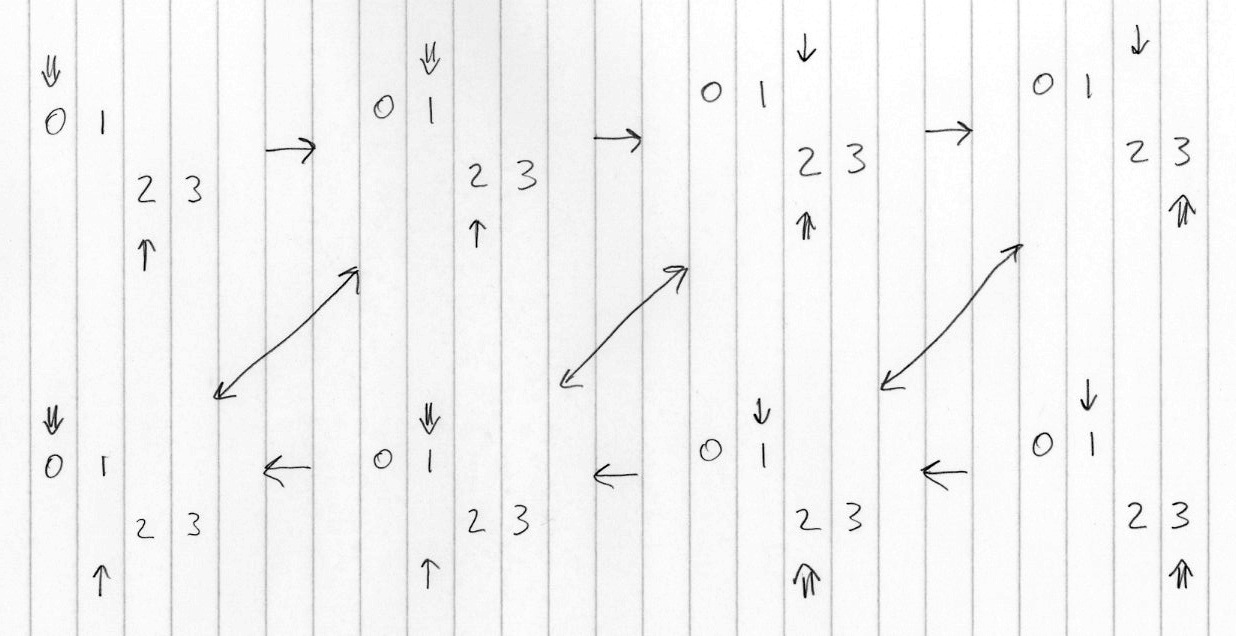
The last problem I ran into was a tricky one. In order to defer btree updates till commit, I use transaction local btrees. Which means to access an index you have to look at both the local and the global btrees. To do this I use an iterator that merges two other iterators. Iterating through two sorted sequences in parallel is a standard easy problem. But Suneido allows you to bidirectionally step forwards or backwards in any order with the same iterator. And it turns out that this makes iterating in parallel a lot tougher. The trick is when you change directions. The final code is not that large (look at next and prev in MergeIndexIter) but I went through about six different versions before I finally got one that appears to work. Of course, most of my previous versions also appeared to work, until I added more test cases.

A big part of finally figuring this out was coming up with the right visualization for it. Here's what I ended up with:


Notice it's paper and pencil. (It should have been on graph paper but I so seldom do stuff on paper anymore that I didn't have any handy.) I would have preferred to do it digital, but I couldn't think of an easy way to do it. I could have done it in a drawing program or even a spreadsheet or word processor, but it would have been a hassle. Drawing programs make it possible to do just about anything, but they'd don't tend to make it easy and natural (at least, if you only use them occasionally like me). Maybe there's a market niche for someone to go after. Or maybe there already is a good program for doing this - anyone know one?

Given the extra complexity, I started to question whether Suneido needed to allow you to switch directions with an iterator. I can only think of a couple of places where we use this. But I'll leave that question for another day.

And now back to testing. I imagine I've still got a few bugs lurking in there. I also need to do some testing and see whether I've actually solved the database growth problem. It may be harder to know whether the transaction issue is solved until we actually get it in production.

Sunday, March 04, 2012

jSuneido Immudb Progress

I've made good progress on the changes to the append-only database storage engine for jSuneido. The new version now passes all the built-in tests, although I have a few things left to do to improve performance.

I'm pretty happy with how it went. No big surprises and the code turned out quite simple for the most part. It's nice that there's less shared mutable state and therefore less potential locking issues.

Previously, updating the shared state and persisting to disk were a combined process. It was a little tricky teasing this apart so they were independent. For example, the semi-immutable data structures were flipping to immutable when they were stored. Now they have to be flipped to immutable before they go into the shared state, separately from being stored.

Of course, the reason I did all these changes was to try to address some "production scale" issues, and I still haven't got to the point where I can really tell if I've solved them or not. So far, the signs are good.

As usual, the code is in Mercurial on SourceForge

Related: Immudb Progress

Sunday, February 19, 2012

Immudb Progress

I've been plugging away at improvements to the immudb append-only storage engine for jSuneido.

To reduce database growth: (see Houston, we have a problem and Problem or Opportunity?)

- Change to persist btree index changes to disks periodically, instead of after every transaction.
- This makes redirection less important so I'm removing it. (Funny how this great idea is suddenly more trouble than it's worth.)
- This also allows persisting btrees in a separate concurrent thread. To make this as independent as possible I plan to split the database into two files. I have mixed feelings about this because I really like having everything in one file. With two files you have to make sure you always backup / restore / copy / move / rename the two files together because if they get out of sync you're in trouble.

To reduce transaction conflicts: (see Suneido Database Transaction Puzzle)

- Instead of tracking reads and writes by btree node, track writes by record and reads by index range and predicate.
- This makes it harder to use the previous approach of merging btree versions. Instead I'm "overlaying" transaction local indexes over the "master" indexes, and then applying the index changes to the master index during commit. (Easy because commits are single-threaded.)


None of these changes is that big, but unfortunately, they are fairly invasive. Rather than "break" everything while the changes are in progress I've been taking a "strangler fig" approach, keeping the existing code intact and functional while at the same time building up a new version that leans heavily on the old one. Once I have the new version functional on its own I can remove the vestiges of the old code.

I should probably be doing these two sets of changes separately, but they keep getting mixed together in my head. I just know where I want to get to, not necessarily which problem each particular change is aimed at. The changes all affect the same code, so in some respects it's easier to do them together. Time will tell whether this was the right approach :-)

Another question is whether the changes I'm working on will actually succeed in reducing database growth sufficiently. I'm actually fairly confident about this because it's not a "yes or no" question. If you persist the indexes after every commit you get the excessive growth I've already seen. At the opposite extreme, if you only persisted at shutdown, you'd get minimal growth. Presumably, the answer lies somewhere between these two extremes. Looking at it another way, if you updated the same btree node in each transaction, if you only saved it once per 10 transactions, then you'd get 1/10th the database growth. If 1/10th is still too big, then you only save every 100 transactions, giving 1/100th the database growth. Since the actual data is still being written to disk at each commit, the only cost of persisting the indexes less often is increased work by crash recovery, which (a) shouldn't happen that often, and (b) processing e.g. 100 commits worth of data to recover from a crash doesn't seem that bad.

Another nice feature of deferring persisting indexes is that it offloads work from commits which are a potential bottleneck since they're single-threaded. There are some issues with persisting indexes concurrently with commits, but I think I have an approach figured out. On the other hand, I'm now updating the master indexes during the commit so it's not all gain.

So far so good. I have some of the pieces working and it's gradually coming together. I'm anxious to see how it turns out.

Wednesday, January 25, 2012

On-line Database Compaction

One of the weaknesses (at least in my mind) of Suneido's database is that it requires off-line compaction. i.e you have to periodically shut down the server and run a standalone compaction process.

Practically speaking, that hasn't been a big issue. With the mutable storage engine, database growth is relatively slow and you don't need to compact that often. Few of our customers run 24 x 7 so it's not a problem to shut down at night occasionally. Also, some of the updates we deploy have to be run single user anyway.

But with the immutable storage engine, even with my improved design, the database will grow faster, and require more frequent compaction.

It would sure be nice if you could compact on-line, in the background, while the server was running.

Thinking about my planned improvements, I realized this might now be relatively easy. (Actually, I think I could have used a similar approach before, it just became more obvious now.)

The basic idea is to use a read-only transaction, and its snapshot of the data base as of a certain point in time, to compact the database up to that point. (Just like the current off-line compaction.)

But since the database is active, you will probably have activity after that point. So then you reprocess any updates after your transaction and apply them to the new database. (This is similar to how crash recovery would reprocess updates that happened after the last good checkpoint.) When you "catch up", then you switch over to the new database (with some synchronization required).

There is a potential problem if the server is so busy that the compaction never catches up. In practice, the compaction could be scheduled at a slow time of the day, and most of our systems aren't continuously busy. In any case, this wouldn't "hurt" anything, other than performance. You could easily detect this situation and abort the compaction.

Although the server can continue to operate during the compaction, performance may be affected. (As it can be with our current on-line backups.) CPU time is usually not the problem these days. A bigger issue is that reading all the data can cause other working set data to be evicted from memory. One option may be to not use virtual memory to read the data. Then you're only competing for disk cache and not virtual memory space. What we've found with our on-line backups is that as long as you have lots of memory it's not a problem.

One benefit of building a new compacted database file (rather than compact in place) is that it is inherently crash proof, at least in the sense that if the server crashes, the current database won't be affected. The new database being created can simply be discarded.

In garbage collector terms this is equivalent to a "copying collector" i.e. it just copies the live data, rather than scanning all the data (live and dead) as, for example, a "mark-sweep" collector does.

Suneido does support on-line backups, taking advantage of snapshot isolation to make a consistent backup as of a certain point in time. With the append only immudb storage engine, another option would be to simply copy the bytes of the database file up to a certain point without paying any attention to interpreting the structure. If the data and indexes are in the same file, this would copy both. If they were in separate files you'd have the option of only copying the data (like the current on-line backup). However, this would still be somewhat larger than the current backup because it would include deleted records. On the other hand, it should be faster since it's just a bulk copy.

Note: These ideas, like my ideas for limiting database growth, are just ideas. I'm sure there are unseen complexities waiting to trip me up.