We took the plunge and converted our (Axon's) in-house accounting and CRM system over to the new version of jSuneido with the immudb append-only storage engine. We have about 50 users so it's a decent test, although we're not as heavy users as some of our customers.
So far so good, it's been running for a couple of days with no glitches.
We'll give it a little longer and then look at converting actual customers.
Showing posts with label immudb. Show all posts
Showing posts with label immudb. Show all posts
Saturday, June 23, 2012
Thursday, June 14, 2012
Optimizing Java Memory Usage

I started by measuring the current memory usage. I used two test cases, first a single table with 400,000 records sorting by a non-indexed field, and second the same table but joined with another one. I used Visual VM to watch the heap and force garbage collections to get an idea of memory usage. The first case used about 200mb and the second about 400mb. For the simple case, that's about 500 bytes per record. I was pretty sure I could improve this usage.
My assumption was that a lot of the usage was Java's per-object overhead.
For each record, the temporary index code created a new sort key record, plus an Object[] array that stored references to each of the source data records (more than one in the case of joins). These sort key arrays are then added to a MergeTree.
My first step was to switch from allocating a separate small array for each sort key, to putting them into a big array and referencing them by offset.
I could have used a standard ArrayList, but it works by doubling the size of it's internal array each time it needs to grow. At very large sizes, this is not the best strategy. For example, to grow from 100mb to 200mb you need to allocate a new 200mb array, copy the old 100mb array into it, and then the old array has to be garbage collected. On top of this, if the data is long lived, it will probably end up being moved to older generations by the garbage collector, where it won't get garbage collected as easily.
Instead, I wrote an ArraysList which uses a bunch of medium sized arrays rather than one big array. To grow it simply allocates another medium size array, without any copying or garbage collecting. This is not necessarily better in every situation, but for my usage it is.
The next problem was that now I was storing an int offset (into the ArraysList) instead of an array. My MergeTree is generic, which means to use if for int's they'd have to be boxed into Integers. Then I'd be back to too much per-object overhead. So I had to make a specialized IntMergeTree. It's too bad that Java makes such a big distinction between primitives and references, and that generics only work with references. (Scala tries to reduce the distinction, and it even lets you specialize a generic class for a primitive type, but it still ends up boxing and unboxing most of the time.)
In the common case where you're just sorting a single table, there's no need for the array at all, and instead of storing the ArraysList offset, you can just store the integer "address" of the record.
The next step was to store the sort key record in larger blocks of memory rather than individually, and again reference them by offset rather than a Java reference. For this I could use the MemStorage class I had already written to create in-memory databases for tests. It inherits from the same Storage base class as my MmapFile memory mapped file access. These are based on ByteBuffers. Each sort key record used at least three memory objects (the record, its ByteBuffer, and the ByteBuffer's array) so this was a significant saving. (This doesn't require much serialization because the sort key records are already in a serialized form.)
The end result was that the memory usage was less than 1/4 of what it was before. My first case now took about 40mb instead of 200mb, and my second case took about 90mb instead of 400mb. Not bad for a couple of days work.
I wouldn't normally recommend this kind of messing around - the overhead is seldom a big issue. But in the case of a server, with large numbers of users competing for memory, I think it was worth it.
Labels:
immudb,
java,
optimization,
performance,
suneido

Wednesday, May 23, 2012
IllegalMonitorStateException and Stack Overflow
Just when I thought immudb was ready to deploy, I got sporadic IllegalMonitorStateException's.
I wasn't sure what that exception meant, but it sounded like concurrency, and that was not good news.
According to the documentation it comes from wait and notify. The catch is that my code doesn't directly use wait and notify. So something that my code uses is in turn using wait and notify.
I tried to catch the exception in the debugger to see where it was coming from, but of course, it never happened when I ran inside the debugger :-(
I started looking around at the docs for concurrency classes that I use and found that ReentrantReadWriteLock WriteLock unlock can throw IllegalMonitorStateException "if the current thread does not hold this lock".
Ouch. My server is NOT thread-per-connection. It uses a thread pool to service requests. So the thread that handles the request that starts a transaction (and acquires the lock) may not be the same thread that handles the request that ends the transaction (and releases the lock).
Because I'm not testing with lots of connections, most of the time all the requests will be handled by the same thread and it will work. But once in a while an additional thread would be used AND would happen to be ending a transaction, and then I'd get this error.
And my concurrency test is equivalent to thread-per-connection so it doesn't run into the problem. That's a weakness in my test, and in this respect the bounded executor I was using before is more equivalent to the actual server.
Of course, I can't guarantee this is the only source of the error, but regardless, it was a bug I needed to fix.
I needed a read-write lock that allowed lock and unlock to be in different threads. I didn't need (or want) it to be reentrant (where the thread holding the lock can acquire it multiple times).
I searched on the web but couldn't find anything.
It looks like it could be written using AbstractQueuedSynchronizer but I'm afraid if I write it myself I'll make some subtle concurrency mistake. I could find various examples of using AbstractQueuedSynchronizer but not a ReadWriteLock.
I'm stumped so I decided to post a question on Stack Overflow. (After searching to make sure there wasn't an existing question.)
I've always been a fan of Stack Overflow. I'm not a heavy user, but I've asked and answered a few questions, and if it comes up in web searches I give it preference. But this time I got a little frustrated with the responses. No one wanted to answer the question - they just wanted to tell me what I was doing was wrong. That's a valid response to some questions, and I have to admit I hadn't really explained the context. I thought the question was specific enough to make the context unnecessary.
I kept clarifying the question and trying to convince the responders that I really did need what I was asking for. It was even more frustrating that people were voting for the responses that just told me I was wrong.
Of course, part of the frustration was that I started to doubt my own design decisions. Maybe I should just be using thread-per-connection - it would have avoided the current issue.
But in the end, Stack Overflow came through again - someone posted an answer that was exactly what I needed. Bizarrely, that answer didn't get as many votes, even though it was the "right" answer.
The answer was to use Semaphore. I hadn't even noticed this class because it's in java.util.concurrent, not in java.util.concurrent.locks where I was looking. I guess it's not a "lock" although it can be used as one.
And when I went to look at the source code for Semaphore, I found that it is implemented (at least in OpenJDK) with AbstractQueuedSynchronizer (which is in java.util.concurrent.locks)
It was simple to write my own read-write lock using Semaphore and everything seems to work fine. I wondered about performance but it seems to be roughly the same as before. I ran some tests and I didn't get any IllegalMonitorStateException's, but it was sporadic before, so that doesn't guarantee it's fixed.
AbstractQueuedSynchronizer has both "shared" and "exclusive" features which seem to map well to read-write locking. But Semaphore doesn't use the exclusive feature. It seems like you could write a read-write lock based on AbstractQueuedSynchronizer that would be a little "cleaner" than Semaphore. But for now at least, I'm happier using something like Semaphore that is tried and tested.
I wasn't sure what that exception meant, but it sounded like concurrency, and that was not good news.
According to the documentation it comes from wait and notify. The catch is that my code doesn't directly use wait and notify. So something that my code uses is in turn using wait and notify.
I tried to catch the exception in the debugger to see where it was coming from, but of course, it never happened when I ran inside the debugger :-(
I started looking around at the docs for concurrency classes that I use and found that ReentrantReadWriteLock WriteLock unlock can throw IllegalMonitorStateException "if the current thread does not hold this lock".
Ouch. My server is NOT thread-per-connection. It uses a thread pool to service requests. So the thread that handles the request that starts a transaction (and acquires the lock) may not be the same thread that handles the request that ends the transaction (and releases the lock).
Because I'm not testing with lots of connections, most of the time all the requests will be handled by the same thread and it will work. But once in a while an additional thread would be used AND would happen to be ending a transaction, and then I'd get this error.
And my concurrency test is equivalent to thread-per-connection so it doesn't run into the problem. That's a weakness in my test, and in this respect the bounded executor I was using before is more equivalent to the actual server.
Of course, I can't guarantee this is the only source of the error, but regardless, it was a bug I needed to fix.
I needed a read-write lock that allowed lock and unlock to be in different threads. I didn't need (or want) it to be reentrant (where the thread holding the lock can acquire it multiple times).
I searched on the web but couldn't find anything.
It looks like it could be written using AbstractQueuedSynchronizer but I'm afraid if I write it myself I'll make some subtle concurrency mistake. I could find various examples of using AbstractQueuedSynchronizer but not a ReadWriteLock.
I'm stumped so I decided to post a question on Stack Overflow. (After searching to make sure there wasn't an existing question.)
I've always been a fan of Stack Overflow. I'm not a heavy user, but I've asked and answered a few questions, and if it comes up in web searches I give it preference. But this time I got a little frustrated with the responses. No one wanted to answer the question - they just wanted to tell me what I was doing was wrong. That's a valid response to some questions, and I have to admit I hadn't really explained the context. I thought the question was specific enough to make the context unnecessary.
I kept clarifying the question and trying to convince the responders that I really did need what I was asking for. It was even more frustrating that people were voting for the responses that just told me I was wrong.
Of course, part of the frustration was that I started to doubt my own design decisions. Maybe I should just be using thread-per-connection - it would have avoided the current issue.
But in the end, Stack Overflow came through again - someone posted an answer that was exactly what I needed. Bizarrely, that answer didn't get as many votes, even though it was the "right" answer.
The answer was to use Semaphore. I hadn't even noticed this class because it's in java.util.concurrent, not in java.util.concurrent.locks where I was looking. I guess it's not a "lock" although it can be used as one.
And when I went to look at the source code for Semaphore, I found that it is implemented (at least in OpenJDK) with AbstractQueuedSynchronizer (which is in java.util.concurrent.locks)
It was simple to write my own read-write lock using Semaphore and everything seems to work fine. I wondered about performance but it seems to be roughly the same as before. I ran some tests and I didn't get any IllegalMonitorStateException's, but it was sporadic before, so that doesn't guarantee it's fixed.
AbstractQueuedSynchronizer has both "shared" and "exclusive" features which seem to map well to read-write locking. But Semaphore doesn't use the exclusive feature. It seems like you could write a read-write lock based on AbstractQueuedSynchronizer that would be a little "cleaner" than Semaphore. But for now at least, I'm happier using something like Semaphore that is tried and tested.
Labels:
concurrency,
database,
immudb,
java,
suneido
Sunday, May 20, 2012
More Immudb Results
The test that I was using to measure concurrency performance was using a bounded executor - code I'd found on the web, back when I knew Java even less than I do now. I decided that it was more complex than it needed to be and I rewrote it just using a number of worker threads. Surprisingly, that seemed to eliminate the drop in performance with more threads.
I also tested on my Windows machine which has a similar CPU but with an SSD (solid state drive) instead of a hard disk. Here are the results:

Now the performance seems to consistently level off as the number of client threads increase. That's less worrying than the performance dropping, but it's still a little puzzling. It still doesn't appear to be due to actual concurrency scaling issues like lock contention. Perhaps it's running into some other limit like storage or memory bandwidth?
Windows + SSD was roughly 2 times as fast as Mac + HD. I suspect that's mostly due to the SSD, although the OS and hardware could also play a part.
immudb also shows more improvement on SSD than the previous version. (blue to red versus orange to green) My guess would be that this is because immudb's large contiguous writes are optimal for SSD.
On both platforms, immudb is about 4 times as fast as the previous version.
I also tested on my Windows machine which has a similar CPU but with an SSD (solid state drive) instead of a hard disk. Here are the results:

Now the performance seems to consistently level off as the number of client threads increase. That's less worrying than the performance dropping, but it's still a little puzzling. It still doesn't appear to be due to actual concurrency scaling issues like lock contention. Perhaps it's running into some other limit like storage or memory bandwidth?
Windows + SSD was roughly 2 times as fast as Mac + HD. I suspect that's mostly due to the SSD, although the OS and hardware could also play a part.
immudb also shows more improvement on SSD than the previous version. (blue to red versus orange to green) My guess would be that this is because immudb's large contiguous writes are optimal for SSD.
On both platforms, immudb is about 4 times as fast as the previous version.
Labels:
concurrency,
database,
immudb,
performance,
suneido
Tuesday, May 15, 2012
Immudb Concurrent Performance Puzzle
One of the tests I hadn't run on immudb (my new append-only database engine for Suneido) was a concurrency test I'd used to debug the previous database engine.
Here are some rough results. As usual, this is not a scientific benchmark. The operations it's doing aren't necessarily representative, and I'm not running it long enough or enough times to get accurate figures. But it still gives me some information.
 I'm pretty happy with the results relative to the previous version. Up to four client threads it's about four times as fast - can't complain about that. And another good result that's not shown by this chart is that immudb has a lot less transaction conflicts.
Also on the positive side, I only found a couple of bugs, and none of them took more than a few minutes to fix. This is a sharp contrast to when I was debugging the previous version. I give credit to the immutability and the resulting reduction in locking.
But I'm puzzled by the drop in performance over 4 threads. And I didn't even include 8 threads because the results were all over the place - anywhere from 3000 to 6000. There's some variation with less threads, but nowhere near this much.
If the performance just levelled off, that would be one thing, but I'm not happy with the performance dropping under heavy load - that's not what you want to see.
The previous version may not perform as well, but it doesn't show the puzzling drop off with more threads. Although, even with the drop, the immudb performance is still much better than the previous version.
At first I was only running 1, 2, 4, and 8 threads. My computer has 4 cores with hyper-threading for more or less 8 hardware threads so I thought maybe it was because I was using up all the hardware threads and not leaving any for other things like garbage collection and the OS. But that wouldn't explain the drop off at 5 threads.
I looked at hprof output, but it didn't give me any clues. It did highlight some areas that I could probably improve, but not related to concurrency. (they were related to one of my pet peeves - ByteBuffer)
More threads could mean more memory usage, but JConsole and VisualVM don't show a lot of time in garbage collection.
The obvious issue is some kind of contention. Immudb doesn't do much locking (because most things are immutable) but I could see contention over the commit lock. But JConsole and VisualVM don't show much waiting for locks. Thread dumps show all the threads as RUNNABLE And I don't see underutilization of the cpus, as I would expect with heavy contention (since they'd be waiting for locks, not executing).
Another possibility is that more concurrent transactions will mean more work to do read validation. And since each commit has to check against all other concurrent transactions, this is ON2 which could be bad. But again, I don't see any signs of it in my monitoring.
And I can't think of any explanation for the excessive variation. Strangely, 16 threads shows much less variation than 8.
I'm more puzzled than worried at this point. In actual usage I don't think it will be an issue because our systems, even the largest ones, won't be applying a continuous load this heavy.
Anyone have any ideas or suggestions of things to look at or try?
Here are some rough results. As usual, this is not a scientific benchmark. The operations it's doing aren't necessarily representative, and I'm not running it long enough or enough times to get accurate figures. But it still gives me some information.
Also on the positive side, I only found a couple of bugs, and none of them took more than a few minutes to fix. This is a sharp contrast to when I was debugging the previous version. I give credit to the immutability and the resulting reduction in locking.
But I'm puzzled by the drop in performance over 4 threads. And I didn't even include 8 threads because the results were all over the place - anywhere from 3000 to 6000. There's some variation with less threads, but nowhere near this much.
If the performance just levelled off, that would be one thing, but I'm not happy with the performance dropping under heavy load - that's not what you want to see.
The previous version may not perform as well, but it doesn't show the puzzling drop off with more threads. Although, even with the drop, the immudb performance is still much better than the previous version.
At first I was only running 1, 2, 4, and 8 threads. My computer has 4 cores with hyper-threading for more or less 8 hardware threads so I thought maybe it was because I was using up all the hardware threads and not leaving any for other things like garbage collection and the OS. But that wouldn't explain the drop off at 5 threads.
I looked at hprof output, but it didn't give me any clues. It did highlight some areas that I could probably improve, but not related to concurrency. (they were related to one of my pet peeves - ByteBuffer)
More threads could mean more memory usage, but JConsole and VisualVM don't show a lot of time in garbage collection.
The obvious issue is some kind of contention. Immudb doesn't do much locking (because most things are immutable) but I could see contention over the commit lock. But JConsole and VisualVM don't show much waiting for locks. Thread dumps show all the threads as RUNNABLE And I don't see underutilization of the cpus, as I would expect with heavy contention (since they'd be waiting for locks, not executing).
Another possibility is that more concurrent transactions will mean more work to do read validation. And since each commit has to check against all other concurrent transactions, this is ON2 which could be bad. But again, I don't see any signs of it in my monitoring.
And I can't think of any explanation for the excessive variation. Strangely, 16 threads shows much less variation than 8.
I'm more puzzled than worried at this point. In actual usage I don't think it will be an issue because our systems, even the largest ones, won't be applying a continuous load this heavy.
Anyone have any ideas or suggestions of things to look at or try?
Labels:
concurrency,
database,
immudb,
performance,
suneido
Thursday, March 29, 2012
More positive immudb results
I'm now at the point where I can successfully run our entire application test suite, not just the stdlib ones. Here's how much the database grows in each version:
cSuneido: 20 mb
immudb1: 400 mb :-(
immudb2: 19 mb :-)
I'm happy that my decision to back up and try a different approach turned out to be a good one.
It's not too surprising that immudb2 gives slightly better results than cSuneido for running tests, since it will often avoid persisting indexes for temporary tables, whereas cSuneido will always write them.
NOTE: This is still not a realistic workload. I suspect immudb will end up having more database growth than cSuneido. But as long as it's not excessive (as these results would tend to indicate) then it's ok.
cSuneido: 20 mb
immudb1: 400 mb :-(
immudb2: 19 mb :-)
I'm happy that my decision to back up and try a different approach turned out to be a good one.
It's not too surprising that immudb2 gives slightly better results than cSuneido for running tests, since it will often avoid persisting indexes for temporary tables, whereas cSuneido will always write them.
NOTE: This is still not a realistic workload. I suspect immudb will end up having more database growth than cSuneido. But as long as it's not excessive (as these results would tend to indicate) then it's ok.
Tuesday, March 27, 2012
Preliminary Immudb Results
I ran a few tests for database growth on the new version of my immudb append-only database storage engine for jSuneido.
First, I tested with persisting indexes every update transaction. This is more or less what it did previously. Then I tested with persisting every so many update transactions.
every 1 = growth 5,882,408
every 10 = growth 1,322,712
every 100 = growth 551,080
every 1000 = growth 354,168
This is the kind of results I was counting on. Deferring persisting the indexes results in much less growth.
Coincidentally, the improvement shown above is about 17 times, not far from the 20 times difference between cSuneido and the first version of immudb. This is just coincidence since I'm running different tests, but it's very nice to see that the improvement may be enough to bring immudb into the same ballpark as cSuneido, which is pretty good considering cSuneido is a mutable database.
Is persisting every 1000 update transactions reasonable? I think so. These tests only take about 5 seconds to run. Remember, the actual data is being written right away, log style, so persisting less often does not increase the risk of losing data. It only increases the amount of work to be done by crash recovery. Making crash recovery re-process 5 seconds (or more) of transactions seems fine. Especially considering that cSuneido rebuilds the entire indexes after a crash, which could take a long time for a big database.
These numbers are from running the stdlib (standard library) tests. This isn't a very typical work load, so the numbers aren't going to be very accurate. But I'm just looking for some very rough feedback at this point. If I'd seen little or no improvement, I'd be seriously depressed right now and considering taking up golf instead :-)
Ideally, I need a good statistical model of a typical work load, or at least representative, since there's probably no such thing as typical. Another project for my "spare" time!
Hmmm... thinking about what the stdlib tests do versus what a typical workload might be, I realized that one atypical thing the stdlib tests do is to create, use, and then drop temporary database tables. But in that case, if you defer persisting till after the table is dropped, then you never need to save the indexes for that table at all. (Although the data will still be written immediately, log style.)
It turned out I wasn't handling this, which actually was good because it would have seriously skewed the above results. It was easy enough to fix.
Rerunning the tests, I got the results I expected - much the same growth when persisting every transaction, less growth than before as the persist interval increased. Persisting every 1000 transactions resulted in a growth of only 62,424 - roughly 5 times better.
This is nice, but not really relevant to production, since a typical workload does not include creating and dropping a lot of temporary tables. It will be nice for development because running the tests won't cause the database to grow so much. (At least until I implement background compaction.)
Persisting every so many update transactions is not necessarily the best approach, I'm using it because it's the easiest. Alternately, you could persist every so many seconds or minutes, or try to persist during "idle" times. Currently, I'm persisting synchronously i.e. while holding the same lock that commits use. So update transactions can't commit till the persist finishes. (But read-only transactions are not affected, and even update transactions can read and write, they just have to wait to commit.) Depending on how much index information has to be persisted, this could introduce delays in server response. To alleviate this, you could persist in a background thread. Because of the immutability, this should be relatively straightforward. The exception is updating the in-memory index information to show it has been saved - this would require some synchronization.
Another issue I haven't dealt with is that I may need to "flush" some of the index information out of memory. Once it's been stored, a btree node in memory consists mainly of a ByteBuffer that points to part of the memory mapped index file. Since the memory mapped space is "virtual", it will get evicted if the OS runs short on memory. But for a really big database, even the small objects referencing the virtual memory may add up to too much memory usage.
It would be easy enough for the persist process to discard the btree nodes once they have been saved. But that would have an effect on performance since they would have to be recreated on-demand. You'd want to evict selectively, presumably on some kind of LRU or NFU basis, which would require tracking some kind of usage data. Presumably, you'd also only want to do this when necessary, i.e. when memory is getting full. Hmmm... perhaps one approach would be to use WeakReference's and let Java worry about when and what to evict. Anyway, that's a challenge for another day.
And now back to testing :-)
First, I tested with persisting indexes every update transaction. This is more or less what it did previously. Then I tested with persisting every so many update transactions.
every 1 = growth 5,882,408
every 10 = growth 1,322,712
every 100 = growth 551,080
every 1000 = growth 354,168
This is the kind of results I was counting on. Deferring persisting the indexes results in much less growth.
Coincidentally, the improvement shown above is about 17 times, not far from the 20 times difference between cSuneido and the first version of immudb. This is just coincidence since I'm running different tests, but it's very nice to see that the improvement may be enough to bring immudb into the same ballpark as cSuneido, which is pretty good considering cSuneido is a mutable database.
Is persisting every 1000 update transactions reasonable? I think so. These tests only take about 5 seconds to run. Remember, the actual data is being written right away, log style, so persisting less often does not increase the risk of losing data. It only increases the amount of work to be done by crash recovery. Making crash recovery re-process 5 seconds (or more) of transactions seems fine. Especially considering that cSuneido rebuilds the entire indexes after a crash, which could take a long time for a big database.
These numbers are from running the stdlib (standard library) tests. This isn't a very typical work load, so the numbers aren't going to be very accurate. But I'm just looking for some very rough feedback at this point. If I'd seen little or no improvement, I'd be seriously depressed right now and considering taking up golf instead :-)
Ideally, I need a good statistical model of a typical work load, or at least representative, since there's probably no such thing as typical. Another project for my "spare" time!
Hmmm... thinking about what the stdlib tests do versus what a typical workload might be, I realized that one atypical thing the stdlib tests do is to create, use, and then drop temporary database tables. But in that case, if you defer persisting till after the table is dropped, then you never need to save the indexes for that table at all. (Although the data will still be written immediately, log style.)
It turned out I wasn't handling this, which actually was good because it would have seriously skewed the above results. It was easy enough to fix.
Rerunning the tests, I got the results I expected - much the same growth when persisting every transaction, less growth than before as the persist interval increased. Persisting every 1000 transactions resulted in a growth of only 62,424 - roughly 5 times better.
This is nice, but not really relevant to production, since a typical workload does not include creating and dropping a lot of temporary tables. It will be nice for development because running the tests won't cause the database to grow so much. (At least until I implement background compaction.)
Persisting every so many update transactions is not necessarily the best approach, I'm using it because it's the easiest. Alternately, you could persist every so many seconds or minutes, or try to persist during "idle" times. Currently, I'm persisting synchronously i.e. while holding the same lock that commits use. So update transactions can't commit till the persist finishes. (But read-only transactions are not affected, and even update transactions can read and write, they just have to wait to commit.) Depending on how much index information has to be persisted, this could introduce delays in server response. To alleviate this, you could persist in a background thread. Because of the immutability, this should be relatively straightforward. The exception is updating the in-memory index information to show it has been saved - this would require some synchronization.
Another issue I haven't dealt with is that I may need to "flush" some of the index information out of memory. Once it's been stored, a btree node in memory consists mainly of a ByteBuffer that points to part of the memory mapped index file. Since the memory mapped space is "virtual", it will get evicted if the OS runs short on memory. But for a really big database, even the small objects referencing the virtual memory may add up to too much memory usage.
It would be easy enough for the persist process to discard the btree nodes once they have been saved. But that would have an effect on performance since they would have to be recreated on-demand. You'd want to evict selectively, presumably on some kind of LRU or NFU basis, which would require tracking some kind of usage data. Presumably, you'd also only want to do this when necessary, i.e. when memory is getting full. Hmmm... perhaps one approach would be to use WeakReference's and let Java worry about when and what to evict. Anyway, that's a challenge for another day.
And now back to testing :-)
Sunday, March 25, 2012
jSuneido immudb milestone
The improved version of the jSuneido append-only storage engine (immudb) now passes all the standard library tests.
Which is great, except it just means I'm right back where I was two months ago with my previous jSuneido immudb milestone. As usual, it feels like I only started on this a couple of weeks ago.
Except that hopefully I've fixed the database growth and transaction conflict issues.
I haven't implemented the idea of passing the table select predicate down to the transaction so it can use it for read validation. But even without this, the conflict detection should be at least as fine grained as cSuneido (and much better than previous versions of jSuneido).
I'm almost to the point where my strangler fig approach has taken over the old immudb code and I should go back and clean it all up so I have a single version. I can't see needing the old immudb version again (and it'll be in version control if I do).
The last problem I ran into was a tricky one. In order to defer btree updates till commit, I use transaction local btrees. Which means to access an index you have to look at both the local and the global btrees. To do this I use an iterator that merges two other iterators. Iterating through two sorted sequences in parallel is a standard easy problem. But Suneido allows you to bidirectionally step forwards or backwards in any order with the same iterator. And it turns out that this makes iterating in parallel a lot tougher. The trick is when you change directions. The final code is not that large (look at next and prev in MergeIndexIter) but I went through about six different versions before I finally got one that appears to work. Of course, most of my previous versions also appeared to work, until I added more test cases.
A big part of finally figuring this out was coming up with the right visualization for it. Here's what I ended up with:

Notice it's paper and pencil. (It should have been on graph paper but I so seldom do stuff on paper anymore that I didn't have any handy.) I would have preferred to do it digital, but I couldn't think of an easy way to do it. I could have done it in a drawing program or even a spreadsheet or word processor, but it would have been a hassle. Drawing programs make it possible to do just about anything, but they'd don't tend to make it easy and natural (at least, if you only use them occasionally like me). Maybe there's a market niche for someone to go after. Or maybe there already is a good program for doing this - anyone know one?
Given the extra complexity, I started to question whether Suneido needed to allow you to switch directions with an iterator. I can only think of a couple of places where we use this. But I'll leave that question for another day.
And now back to testing. I imagine I've still got a few bugs lurking in there. I also need to do some testing and see whether I've actually solved the database growth problem. It may be harder to know whether the transaction issue is solved until we actually get it in production.
Which is great, except it just means I'm right back where I was two months ago with my previous jSuneido immudb milestone. As usual, it feels like I only started on this a couple of weeks ago.
Except that hopefully I've fixed the database growth and transaction conflict issues.
I haven't implemented the idea of passing the table select predicate down to the transaction so it can use it for read validation. But even without this, the conflict detection should be at least as fine grained as cSuneido (and much better than previous versions of jSuneido).
I'm almost to the point where my strangler fig approach has taken over the old immudb code and I should go back and clean it all up so I have a single version. I can't see needing the old immudb version again (and it'll be in version control if I do).
The last problem I ran into was a tricky one. In order to defer btree updates till commit, I use transaction local btrees. Which means to access an index you have to look at both the local and the global btrees. To do this I use an iterator that merges two other iterators. Iterating through two sorted sequences in parallel is a standard easy problem. But Suneido allows you to bidirectionally step forwards or backwards in any order with the same iterator. And it turns out that this makes iterating in parallel a lot tougher. The trick is when you change directions. The final code is not that large (look at next and prev in MergeIndexIter) but I went through about six different versions before I finally got one that appears to work. Of course, most of my previous versions also appeared to work, until I added more test cases.
A big part of finally figuring this out was coming up with the right visualization for it. Here's what I ended up with:
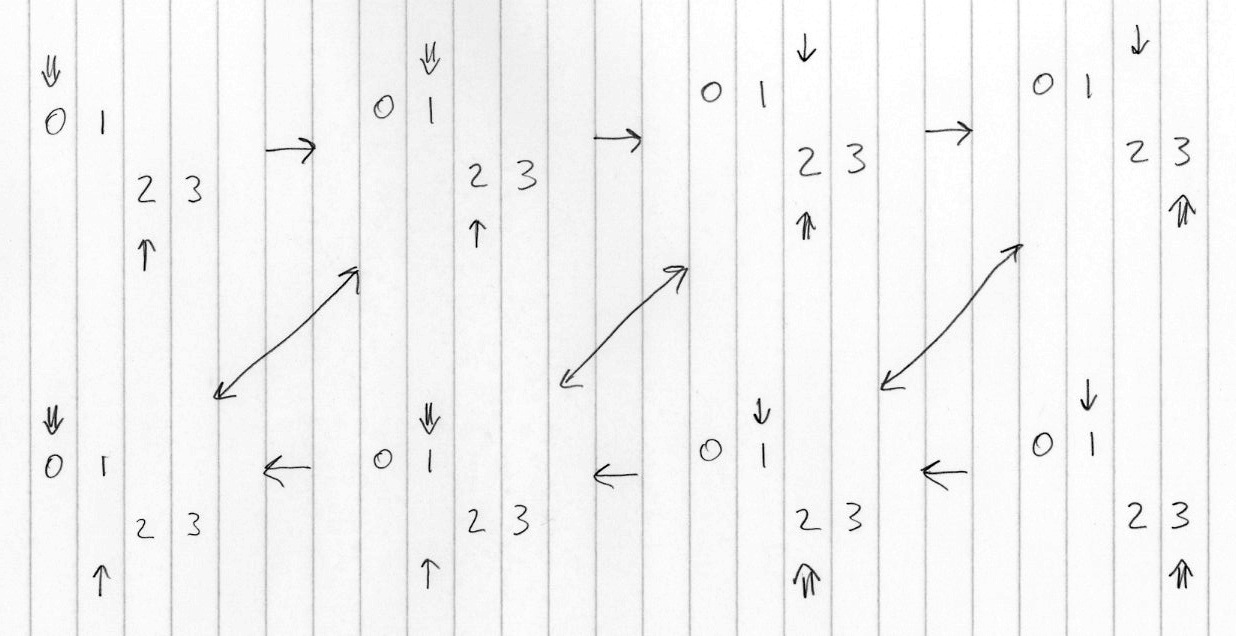
Notice it's paper and pencil. (It should have been on graph paper but I so seldom do stuff on paper anymore that I didn't have any handy.) I would have preferred to do it digital, but I couldn't think of an easy way to do it. I could have done it in a drawing program or even a spreadsheet or word processor, but it would have been a hassle. Drawing programs make it possible to do just about anything, but they'd don't tend to make it easy and natural (at least, if you only use them occasionally like me). Maybe there's a market niche for someone to go after. Or maybe there already is a good program for doing this - anyone know one?
Given the extra complexity, I started to question whether Suneido needed to allow you to switch directions with an iterator. I can only think of a couple of places where we use this. But I'll leave that question for another day.
And now back to testing. I imagine I've still got a few bugs lurking in there. I also need to do some testing and see whether I've actually solved the database growth problem. It may be harder to know whether the transaction issue is solved until we actually get it in production.
Sunday, March 04, 2012
jSuneido Immudb Progress
I've made good progress on the changes to the append-only database storage engine for jSuneido. The new version now passes all the built-in tests, although I have a few things left to do to improve performance.
I'm pretty happy with how it went. No big surprises and the code turned out quite simple for the most part. It's nice that there's less shared mutable state and therefore less potential locking issues.
Previously, updating the shared state and persisting to disk were a combined process. It was a little tricky teasing this apart so they were independent. For example, the semi-immutable data structures were flipping to immutable when they were stored. Now they have to be flipped to immutable before they go into the shared state, separately from being stored.
Of course, the reason I did all these changes was to try to address some "production scale" issues, and I still haven't got to the point where I can really tell if I've solved them or not. So far, the signs are good.
As usual, the code is in Mercurial on SourceForge
Related: Immudb Progress
I'm pretty happy with how it went. No big surprises and the code turned out quite simple for the most part. It's nice that there's less shared mutable state and therefore less potential locking issues.
Previously, updating the shared state and persisting to disk were a combined process. It was a little tricky teasing this apart so they were independent. For example, the semi-immutable data structures were flipping to immutable when they were stored. Now they have to be flipped to immutable before they go into the shared state, separately from being stored.
Of course, the reason I did all these changes was to try to address some "production scale" issues, and I still haven't got to the point where I can really tell if I've solved them or not. So far, the signs are good.
As usual, the code is in Mercurial on SourceForge
Related: Immudb Progress
Sunday, February 19, 2012
Immudb Progress
I've been plugging away at improvements to the immudb append-only storage engine for jSuneido.
To reduce database growth: (see Houston, we have a problem and Problem or Opportunity?)
- Change to persist btree index changes to disks periodically, instead of after every transaction.
- This makes redirection less important so I'm removing it. (Funny how this great idea is suddenly more trouble than it's worth.)
- This also allows persisting btrees in a separate concurrent thread. To make this as independent as possible I plan to split the database into two files. I have mixed feelings about this because I really like having everything in one file. With two files you have to make sure you always backup / restore / copy / move / rename the two files together because if they get out of sync you're in trouble.
To reduce transaction conflicts: (see Suneido Database Transaction Puzzle)
- Instead of tracking reads and writes by btree node, track writes by record and reads by index range and predicate.
- This makes it harder to use the previous approach of merging btree versions. Instead I'm "overlaying" transaction local indexes over the "master" indexes, and then applying the index changes to the master index during commit. (Easy because commits are single-threaded.)

None of these changes is that big, but unfortunately, they are fairly invasive. Rather than "break" everything while the changes are in progress I've been taking a "strangler fig" approach, keeping the existing code intact and functional while at the same time building up a new version that leans heavily on the old one. Once I have the new version functional on its own I can remove the vestiges of the old code.
I should probably be doing these two sets of changes separately, but they keep getting mixed together in my head. I just know where I want to get to, not necessarily which problem each particular change is aimed at. The changes all affect the same code, so in some respects it's easier to do them together. Time will tell whether this was the right approach :-)
To reduce database growth: (see Houston, we have a problem and Problem or Opportunity?)
- Change to persist btree index changes to disks periodically, instead of after every transaction.
- This makes redirection less important so I'm removing it. (Funny how this great idea is suddenly more trouble than it's worth.)
- This also allows persisting btrees in a separate concurrent thread. To make this as independent as possible I plan to split the database into two files. I have mixed feelings about this because I really like having everything in one file. With two files you have to make sure you always backup / restore / copy / move / rename the two files together because if they get out of sync you're in trouble.
To reduce transaction conflicts: (see Suneido Database Transaction Puzzle)
- Instead of tracking reads and writes by btree node, track writes by record and reads by index range and predicate.
- This makes it harder to use the previous approach of merging btree versions. Instead I'm "overlaying" transaction local indexes over the "master" indexes, and then applying the index changes to the master index during commit. (Easy because commits are single-threaded.)

None of these changes is that big, but unfortunately, they are fairly invasive. Rather than "break" everything while the changes are in progress I've been taking a "strangler fig" approach, keeping the existing code intact and functional while at the same time building up a new version that leans heavily on the old one. Once I have the new version functional on its own I can remove the vestiges of the old code.
I should probably be doing these two sets of changes separately, but they keep getting mixed together in my head. I just know where I want to get to, not necessarily which problem each particular change is aimed at. The changes all affect the same code, so in some respects it's easier to do them together. Time will tell whether this was the right approach :-)
Another question is whether the changes I'm working on will actually succeed in reducing database growth sufficiently. I'm actually fairly confident about this because it's not a "yes or no" question. If you persist the indexes after every commit you get the excessive growth I've already seen. At the opposite extreme, if you only persisted at shutdown, you'd get minimal growth. Presumably, the answer lies somewhere between these two extremes. Looking at it another way, if you updated the same btree node in each transaction, if you only saved it once per 10 transactions, then you'd get 1/10th the database growth. If 1/10th is still too big, then you only save every 100 transactions, giving 1/100th the database growth. Since the actual data is still being written to disk at each commit, the only cost of persisting the indexes less often is increased work by crash recovery, which (a) shouldn't happen that often, and (b) processing e.g. 100 commits worth of data to recover from a crash doesn't seem that bad.
Another nice feature of deferring persisting indexes is that it offloads work from commits which are a potential bottleneck since they're single-threaded. There are some issues with persisting indexes concurrently with commits, but I think I have an approach figured out. On the other hand, I'm now updating the master indexes during the commit so it's not all gain.
So far so good. I have some of the pieces working and it's gradually coming together. I'm anxious to see how it turns out.
So far so good. I have some of the pieces working and it's gradually coming together. I'm anxious to see how it turns out.
Wednesday, January 25, 2012
On-line Database Compaction
One of the weaknesses (at least in my mind) of Suneido's database is that it requires off-line compaction. i.e you have to periodically shut down the server and run a standalone compaction process.
Practically speaking, that hasn't been a big issue. With the mutable storage engine, database growth is relatively slow and you don't need to compact that often. Few of our customers run 24 x 7 so it's not a problem to shut down at night occasionally. Also, some of the updates we deploy have to be run single user anyway.
But with the immutable storage engine, even with my improved design, the database will grow faster, and require more frequent compaction.
It would sure be nice if you could compact on-line, in the background, while the server was running.
Thinking about my planned improvements, I realized this might now be relatively easy. (Actually, I think I could have used a similar approach before, it just became more obvious now.)
The basic idea is to use a read-only transaction, and its snapshot of the data base as of a certain point in time, to compact the database up to that point. (Just like the current off-line compaction.)
But since the database is active, you will probably have activity after that point. So then you reprocess any updates after your transaction and apply them to the new database. (This is similar to how crash recovery would reprocess updates that happened after the last good checkpoint.) When you "catch up", then you switch over to the new database (with some synchronization required).
Practically speaking, that hasn't been a big issue. With the mutable storage engine, database growth is relatively slow and you don't need to compact that often. Few of our customers run 24 x 7 so it's not a problem to shut down at night occasionally. Also, some of the updates we deploy have to be run single user anyway.
But with the immutable storage engine, even with my improved design, the database will grow faster, and require more frequent compaction.
It would sure be nice if you could compact on-line, in the background, while the server was running.
Thinking about my planned improvements, I realized this might now be relatively easy. (Actually, I think I could have used a similar approach before, it just became more obvious now.)
The basic idea is to use a read-only transaction, and its snapshot of the data base as of a certain point in time, to compact the database up to that point. (Just like the current off-line compaction.)
But since the database is active, you will probably have activity after that point. So then you reprocess any updates after your transaction and apply them to the new database. (This is similar to how crash recovery would reprocess updates that happened after the last good checkpoint.) When you "catch up", then you switch over to the new database (with some synchronization required).
There is a potential problem if the server is so busy that the compaction never catches up. In practice, the compaction could be scheduled at a slow time of the day, and most of our systems aren't continuously busy. In any case, this wouldn't "hurt" anything, other than performance. You could easily detect this situation and abort the compaction.
Although the server can continue to operate during the compaction, performance may be affected. (As it can be with our current on-line backups.) CPU time is usually not the problem these days. A bigger issue is that reading all the data can cause other working set data to be evicted from memory. One option may be to not use virtual memory to read the data. Then you're only competing for disk cache and not virtual memory space. What we've found with our on-line backups is that as long as you have lots of memory it's not a problem.
One benefit of building a new compacted database file (rather than compact in place) is that it is inherently crash proof, at least in the sense that if the server crashes, the current database won't be affected. The new database being created can simply be discarded.
In garbage collector terms this is equivalent to a "copying collector" i.e. it just copies the live data, rather than scanning all the data (live and dead) as, for example, a "mark-sweep" collector does.
In garbage collector terms this is equivalent to a "copying collector" i.e. it just copies the live data, rather than scanning all the data (live and dead) as, for example, a "mark-sweep" collector does.
Suneido does support on-line backups, taking advantage of snapshot isolation to make a consistent backup as of a certain point in time. With the append only immudb storage engine, another option would be to simply copy the bytes of the database file up to a certain point without paying any attention to interpreting the structure. If the data and indexes are in the same file, this would copy both. If they were in separate files you'd have the option of only copying the data (like the current on-line backup). However, this would still be somewhat larger than the current backup because it would include deleted records. On the other hand, it should be faster since it's just a bulk copy.
Note: These ideas, like my ideas for limiting database growth, are just ideas. I'm sure there are unseen complexities waiting to trip me up.
Saturday, January 21, 2012
Problem or Opportunity?
I started to get a little worried about the database growth problem with my immudb append-only storage engine for jSuneido. I could think of ways to reduce the growth a little bit, but not by much, and only at the cost of adding a bunch of complexity.
Was I going to have to throw out a year's work, when it seemed so promising? Having to throw out a few day's work is one thing, but a year? How could I have gone so far without seeing this problem? Especially since I knew perfectly well it was an issue with this approach.
I'm as much an eternal optimist as the next programmer, with a big enough ego to think I can solve most problems. But I'm also human with the standard intermittent feelings of inadequacy and stupidity. In other words, I was starting to worry. But I knew enough to give myself time to mull it over.
I was sitting eating lunch, reading a computer book when I started to think about the problem.
What if I wrote out the redirections as just a list of values? That would be a lot more compact than saving the changes to the hash trie. That would be fine while you were running because you'd still have the hash trie in memory. But what about restarting? How would you get the in-memory hash trie back? And how would you handle crash recovery?
It seemed like the problem wasn't so much the way I was saving the information, it was saving it so often, for every transaction. I did this so the on-disk data structure matched the in-memory data structure after every transaction commit.
But was that strictly necessary? What if you relaxed that constraint? What if you only wrote out all the extra information (btree nodes, redirections, db info) periodically? That would reduce the database growth a lot. You could then consider a continuum, from saving after every commit, to the opposite extreme of only saving when you shut down the server.
I realized that what I was thinking about was basically the idea of "checkpoints" - a standard database implementation technique. You could also think of it as simply deferring index writes to disk.
Crash recovery becomes a little harder - you'd have to start from the last good checkpoint and reprocess the data from transactions after that. Similar to how other database crash recovery reprocesses logs from the last checkpoint. This isn't quite as elegant or simple as being able to simply pick up from the last good commit, but crashes don't happen that often. And it was still a lot better than having to rebuild all the indexes after a crash as Suneido requires with the current mutable storage engine.
The beauty of this solution is that it doesn't require a lot of changes. The immutable persistent in-memory data structures and the code that uses them stays exactly the same. You just don't save it as often.
Of course, taanstaafl. The cost of this approach would be higher memory usage. Once the index changes are saved to disk you don't have to keep the in-memory versions. Obviously, if you don't save to disk, you do have to keep the in-memory versions. However, the memory cost is much less than the disk growth because the memory will be garbage collected. Memory is cheap and jSuneido assumes you have lots. (For small systems with limited memory, cSuneido is a better choice.)
Another benefit from saving after multiple transactions is that there can be considerable overlap. For example, if there are "hotspots" in the data that are frequently updated, you only save them once per checkpoint instead of once per commit.
So the commits would simply save the data records (inserts, updates, and deletes) to the database file, with no other information. The btrees would be updated in-memory only. Then periodically you would save a checkpoint with the btree and db info changes.
Thinking about it, I wonder if I needed the redirections with this approach. The point of the redirections is to save space by not path copying to the root. But periodic checkpoints may save enough space that redirections aren't as important. Eliminating them would definitely simplify the code - always a good thing!
I also realized that I could even write the checkpoints in a separate concurrent thread since they could use the persistent immutable data structures to view the state as of a certain point in time (just like transactions do) without any concurrency issues and without blocking ongoing database activity. The only trick would be coordinating writing to the database file. Even that coordination could be avoided if you wrote the checkpoints (i.e. the index btrees) to a separate file from the data. Although I like having everything in one file, it's certainly not essential.
They say that creative problem solving is a lot about combining known, existing pieces into new combinations. I had all the pieces I needed to solve this problem, I just had to put them together. (Ironically, I talked about a lot of the same pieces almost two years ago in A Faster, Cleaner Database Design for Suneido)
And so I go from thoughts of a depressing major failure, to feeling like a kid with a new Lego kit :-)
Was I going to have to throw out a year's work, when it seemed so promising? Having to throw out a few day's work is one thing, but a year? How could I have gone so far without seeing this problem? Especially since I knew perfectly well it was an issue with this approach.
I'm as much an eternal optimist as the next programmer, with a big enough ego to think I can solve most problems. But I'm also human with the standard intermittent feelings of inadequacy and stupidity. In other words, I was starting to worry. But I knew enough to give myself time to mull it over.
I was sitting eating lunch, reading a computer book when I started to think about the problem.
What if I wrote out the redirections as just a list of values? That would be a lot more compact than saving the changes to the hash trie. That would be fine while you were running because you'd still have the hash trie in memory. But what about restarting? How would you get the in-memory hash trie back? And how would you handle crash recovery?
It seemed like the problem wasn't so much the way I was saving the information, it was saving it so often, for every transaction. I did this so the on-disk data structure matched the in-memory data structure after every transaction commit.
But was that strictly necessary? What if you relaxed that constraint? What if you only wrote out all the extra information (btree nodes, redirections, db info) periodically? That would reduce the database growth a lot. You could then consider a continuum, from saving after every commit, to the opposite extreme of only saving when you shut down the server.
I realized that what I was thinking about was basically the idea of "checkpoints" - a standard database implementation technique. You could also think of it as simply deferring index writes to disk.
Crash recovery becomes a little harder - you'd have to start from the last good checkpoint and reprocess the data from transactions after that. Similar to how other database crash recovery reprocesses logs from the last checkpoint. This isn't quite as elegant or simple as being able to simply pick up from the last good commit, but crashes don't happen that often. And it was still a lot better than having to rebuild all the indexes after a crash as Suneido requires with the current mutable storage engine.
The beauty of this solution is that it doesn't require a lot of changes. The immutable persistent in-memory data structures and the code that uses them stays exactly the same. You just don't save it as often.
Of course, taanstaafl. The cost of this approach would be higher memory usage. Once the index changes are saved to disk you don't have to keep the in-memory versions. Obviously, if you don't save to disk, you do have to keep the in-memory versions. However, the memory cost is much less than the disk growth because the memory will be garbage collected. Memory is cheap and jSuneido assumes you have lots. (For small systems with limited memory, cSuneido is a better choice.)
Another benefit from saving after multiple transactions is that there can be considerable overlap. For example, if there are "hotspots" in the data that are frequently updated, you only save them once per checkpoint instead of once per commit.
So the commits would simply save the data records (inserts, updates, and deletes) to the database file, with no other information. The btrees would be updated in-memory only. Then periodically you would save a checkpoint with the btree and db info changes.
Thinking about it, I wonder if I needed the redirections with this approach. The point of the redirections is to save space by not path copying to the root. But periodic checkpoints may save enough space that redirections aren't as important. Eliminating them would definitely simplify the code - always a good thing!
I also realized that I could even write the checkpoints in a separate concurrent thread since they could use the persistent immutable data structures to view the state as of a certain point in time (just like transactions do) without any concurrency issues and without blocking ongoing database activity. The only trick would be coordinating writing to the database file. Even that coordination could be avoided if you wrote the checkpoints (i.e. the index btrees) to a separate file from the data. Although I like having everything in one file, it's certainly not essential.
They say that creative problem solving is a lot about combining known, existing pieces into new combinations. I had all the pieces I needed to solve this problem, I just had to put them together. (Ironically, I talked about a lot of the same pieces almost two years ago in A Faster, Cleaner Database Design for Suneido)
And so I go from thoughts of a depressing major failure, to feeling like a kid with a new Lego kit :-)
Thursday, January 19, 2012
Houston, we have a problem

Then I noticed the amount of database growth when I ran our full application test suite:
mutable storage engine = 20mb
immutable storage engine = 400mb
Ouch. I always expected it to use more space - that's the cost of immutable persistent data structures. But I didn't expect it to be 20 times as much.
With immutable persistent data structures in memory, the space is reclaimed by garbage collection. But so far the only form of garbage collection for database space that Suneido has had is offline compaction.
It's a little surprising that the performance is good, even on hard disk rather than SSD. I assume that's because sequential writes are actually quite fast. And also because it's using memory mapped file access so it's not blocking.
Given that the performance is ok, the database growth might even be acceptable. It might just mean compacting the database nightly instead of weekly as we currently do. However, presumably the performance would be even better if it wasn't writing so much.
I think it's worth spending some time to see if I can improve it. The first step was to see what the breakdown of the space was. (Note: these figures are growth, not total size.)
96820 update transactions
data space 11 mb
btree node space 140 mb
redirection space 89 mb
db info space 148 mb
If you look at the growth per transaction it's only about 4 kb. That doesn't sound too bad, until you have 100,000 transactions.
The btree node space could likely be decreased a lot (maybe half?) by compression of the nodes, perhaps something as simple as prefix compression.
Redirection is used to avoid path copying all the way to the root in the btrees. It's stored as an immutable persistent hash trie. Unfortunately, it does have to do path copying itself and that may be part of the problem.
I also noticed that each subsequent run used more redirection space. That's a little curious because it's doing the same set of updates each time. However, as the total number of redirections grows, then path copying will grow.
The "db info" is another hash trie containing aggregate data about each table and index. The information is used for query optimization. It could use redirection instead of path copying but currently it doesn't because it's using the same hash trie implementation as the redirections. It currently stores a "blob" of information for each table.
One improvement would be to delete redirection and db info when a table or index is destroyed. However, this would help the tests more than actual application usage, since the tests create and destroy lots of temporary tables. This might mean actual application usage would not show as high database growth as the tests.
I'm not sure what to try first. It's too bad the space is coming from three similarly sized sources. If the majority had come from one source then that would be the obvious place to start. There's always a chance that there are bugs or design flaws causing part of the problem. Another variable to try adjusting is btree node size.
* You could argue that our application test suite ideally shouldn't be hitting the database at all. But that's not relevant to this post.
** The title of this post comes from Apollo 13
Thursday, January 12, 2012
jSuneido immudb milestone
As of today, my new append-only storage engine for jSuneido (immudb) successfully runs all our application tests. Of course, there are probably still bugs, but it's a big milestone.
And it runs the standard library portion of the tests roughly twice as fast as with the previous storage engine. It also loads databases from a dump roughly twice as fast. And crash recovery is hugely faster.
Overall, I'm pleased with how it's worked out, other than the transactions issues I posted about recently.
As usual, I was surprised when I looked at how long it's been since I started on this - almost exactly a year! Of course, I wasn't working on it full time, and I had to do quite a lot of refactoring on jSuneido to allow pluggable storage engines, but still a lot of work.
Next, I'm planning to work on the transaction issues. Hopefully that won't take a year!
See also: all the posts related to immudb
And it runs the standard library portion of the tests roughly twice as fast as with the previous storage engine. It also loads databases from a dump roughly twice as fast. And crash recovery is hugely faster.
Overall, I'm pleased with how it's worked out, other than the transactions issues I posted about recently.
As usual, I was surprised when I looked at how long it's been since I started on this - almost exactly a year! Of course, I wasn't working on it full time, and I had to do quite a lot of refactoring on jSuneido to allow pluggable storage engines, but still a lot of work.
Next, I'm planning to work on the transaction issues. Hopefully that won't take a year!
See also: all the posts related to immudb
Sunday, January 08, 2012
Suneido Database Transaction Puzzle

[Disclaimer - this post is largely to clarify and review my own thinking. My apologies if it's somewhat cryptic.]
A lot of the conflicts could be traced back to application issues that we could fix e.g. having an alert inside a transaction (so the transaction was kept open too long) or not retrying.
But there were still too many conflicts. I ended up adding an option for snapshot isolation rather than serializable snapshot isolation. That eliminated most of the conflicts, but it opens up the potential for inconsistencies and I'm not really happy with it.
My initial assumption was that jSuneido was more "strict" than cSuneido and that was why there were more conflicts. jSuneido implements the algorithm from Serializable Isolation for Snapshot Databases by Cahill, Rohm, and Fekete [CRF], whereas cSuneido does "read validation" i.e. when a transaction commits it verifies that all of its reads are still valid.
But when I thought about the two approaches, I realized that cSuneido's read validation is actually more restrictive than jSuneido's CRF algorithm. Read validation requires transactions to serialize as of their commit time, whereas CRF allows re-ordering (as long as there are no dependency cycles that would prevent it). Otherwise, they are basically doing the same thing.
So I was back to trying to figure out why jSuneido was getting more conflicts.
The CRF approach does admit some "false positives" i.e. spurious conflicts that are not really conflicts. Because it's an "incremental" approach, the conflict flags can get set by transactions that don't end up overlapping or that later abort. As the rate of conflicts rises, this effect will get worse. It's possible this accounts for some of the jSuneido conflicts but I don't think it's the main reason. (Note: cSuneido's read validation only looks at committed transactions so it doesn't degrade in this fashion.)
One major difference is that jSuneido tracks reads and writes by B-tree index node rather than by individual record. This handles phantoms and simplifies merging transaction updates, but it can lead to more conflicts. For example, if a table only has only a few rows, then all updates will be in the the same B-tree node and overlapping transactions will always conflict. Similarly, appending keys at the end of an index is likely to conflict due to updating the same node.
cSuneido handles phantoms by tracking the index ranges that a transaction reads. Read validation then checks whether any concurrent writes from other transactions fell within those ranges.
My current thinking is that tracking reads and writes by B-tree node is what accounts for jSuneido getting more conflicts, although I don't have an easy way to "prove" this. If I'm correct, then the solution is to track index ranges rather than B-tree nodes. But, that's not so easy with CRF since it uses read locks on items - harder to do with ranges. And you have to deal with concurrent changes to B-tree nodes, which would require a complex tree merge.
So I think I'll probably go back to read validation instead of the CRF approach. It does mean more work during commits, and since commits are single-threaded, that will reduce the concurrency of commits. On the other hand, CRF required access to shared locks which reduces the concurrency of reads and writes. And if commits did turn out to be a bottle-neck, I think it would be relatively easy to multi-thread the commit process e.g. using one task per index. (Since indexes are independent, this should parallelize well.)
But it still leaves the question of how to handle concurrent B-tree updates if I'm no longer "locking" nodes. One approach I've been considering is to delay updating the actual "master" B-tree indexes until a transaction commits. Then the updates are single-threaded and there are no concurrent updates to deal with. Again, this puts more work into the commit, but I think this can be addressed as above.
(cSuneido handles this issue by keeping multiple versions of keys in the B-tree nodes. But this is tricky and doesn't fit well with the append-only approach that I'm concentrating on.)
However, transactions still need to "see" their own updates, so you'd have to have some kind of additional per-transaction indexes that you would transparently "merge" with the master ones. These could be B-tree indexes, but since they are in-memory, there are probably better data structures. One possibility is a "merge tree". I called this a "fractal tree" in a couple of blog posts (here and here) but the simple structure I'm talking about is not really the same as Tokutek's fractal tree. Since those blog posts I wrote an improved version (MergeTree.java) which I'm now using for temporary indexes required by queries.
A merge tree will be fast for inserts (faster than a B-tree) but slower for lookups. Accumulating updates in a per-transaction merge tree and then applying them to the master B-tree during commit will also have the side benefit of applying the updates to the B-tree in sorted order, which is optimal for B-trees.
Thinking about this, I have an idea for another potentially large optimization. Serializability really only cares about the records that the application sees. This is not the same as the records that the low level query execution reads. For example, if you have an index on fields a,b,c and you query on b, the low level code will scan the entire index, perhaps only returning a few records (possibly none). If you just track the index range that was read by the low level code, then it will appear that all the records were read. This will mean a much greater chance of conflicts than if you tracked the records that the application actually received.
However, I don't want to mix levels and have the query execution code worry about transaction read tracking. I think what I can do is have the query code pass a "black box" predicate to the low level database code. Then the transaction read validation can use the predicate when validating reads. i.e. writes by other transactions that do not match the predicate cannot have been seen and can be ignored.
One remaining issue is "bulk" updates since none of these approaches are great for updating a huge number of records. It may be reasonable to allow the application code to "lock" a table. This would prevent concurrent updates, and would allow updating the master B-trees directly, without accumulating updates in memory.
The problem with all of this is that it relies on an embarrassing amount of guess work and seat of the pants intuition. (Based on a fair bit of experience, but even experienced intuition is probably wrong as often as it's right.) Ideally, you'd test out these ideas before jumping into implementing them. But it's just not feasible. Any one of these issues would make a good research project. And even then, you'd only have analyzed a single issue - not how it relates to all the other issues.
The solution space is just too large. Which, of course, is also what makes it fun. It would be pretty boring if it was simple enough to analyze exhaustively, and have no questions about the best approach. The chances of me stumbling on a solution that is better than what is out there is slim, but at least it exists.
The timing actually isn't too bad. I'm just finishing up debugging the append-only storage engine. (So far, the performance looks promising, perhaps as much as twice as fast.) Once I finish that I can take a look at these transaction ideas and see what I can do.
Labels:
algorithms,
concurrency,
database,
immudb,
suneido
Tuesday, September 06, 2011
Concurrency Continued
I figured I'd better write a concurrency stress test for my DbHashTrie semi-immutable data structure, to increase my confidence that there were no problems. (Of course, a test can never prove the absence of problems.)
I write my test and it passes. But as a good cynical/skeptical tester, I tweak it so it should fail. It still passes?! I realize that I'm running in multiple threads and if an assert fails it'll just throw an exception and that thread will silently die, swallowing the exception. Oops. I add try-catch around the thread body.
Now it fails, as expected. I remove the tweak, expecting it to now succeed. It still fails! I remove the multi-threading. It still fails. Huh!? This code is in live use, if there's a bug, that's definitely not good.
After thrashing for a (thankfully short) time, I realize it was a bug in my test, not the actual code. To make it worse, I've been caught by the same thing multiple times. Some day I'll learn! When building a map-like data structure with random keys, you have to remember that you could get duplicate keys, which in most maps will overwrite the previous value. If your test checks for the original value, it'll fail since it'll get the new value.
Finally the test seems to be working properly. Except that it's not maxing out my cores. Since it's entirely in memory, with no IO, I can't see why it wouldn't. I play around with various parameters like the number of threads, size of data, and number of iterations but it still doesn't max out my cpu usage. (I use iStat Menus to show my cpu usage all the time on the menu bar so I can easily monitor what's going on.)
The only thing I can think of is the locking. I comment out the two places with synchronized and re-run the tests. Voila, all eight cores at 100%. Not normally what you want to see, but in this case it was.
Hmmm... if it wasn't maxing out the cpu, it must have been running slower. I add some timing. Yikes, the synchronized version is over 10 times slower! (45 seconds with synchronized, 3.8 seconds without.)
Of course, this is close to a worst case scenario since the test doesn't do much more than call the one synchronized method. And although the locking is per node, every access has to start at the root node. Java locks are very fast these days, but only when uncontested. And in this case the nodes at the root of the tree will be heavily contested.
If it was a single variable I could just make it volatile, but it's an array, and putting volatile on an array only makes the reference volatile, not the contents. That's where AtomicReferenceArray comes in. It had crossed my mind a few times, but the interface is quite different from an array so it would be a bit of a hassle to switch. I'd also have to write my own versions of Arrays.copyOf and System.arraycopy
I changed the code to use AtomicReferenceArray. It was a bit slower than the raw array, but not a lot (5 seconds, versus 3.8).
I also did some checking, and the JVM spec does guarantee that updates are atomic (except for long's and double's). So I think I'm safe not doing anything special for concurrent access. That means threads could read stale values. Which means there could potentially be a data race where two threads could end up loading the same node at the same time. But as far as I can figure, this should be benign since they will both get the same node (it's never modified in the memory-mapped file) and therefore it doesn't matter which one wins. I think it's equivalent to how String calculates its hashCode lazily.
The question is, do I trust this reasoning? Or do I go with the safer, but slower and uglier AtomicReferenceArray?
A little searching on the web turns up: Date-Race-Ful Lazy Initialization for Performance. Ironically, this both confirms my reasoning, and also identifies a bug in my code. I was accessing the shared variable more than once in my code, which can lead to problems due to memory access re-ordering. Easily fixed, but yet another example that it's hard to reason correctly about this stuff. (Just to hammer the point home, another article I found, Implementing hashCode, has the same bug with reading the variable multiple times without using volatile.)
The blog post also references a section in Effective Java (2nd ed) by Joshua Bloch so I dig my copy out and review it. It confirms that the single-check idiom is valid, but also recommends using double checked locking with a volatile variable instead. Even for the single check idiom, it recommends using a volatile variable, although it's not strictly necessary.
After all that, I think I'm going to go with the simplest code with the raw array, non-volatile, and unsynchronized. That's not because I trust my reasoning, but because I trust the explanation and examples of people who are much smarter than me.
I write my test and it passes. But as a good cynical/skeptical tester, I tweak it so it should fail. It still passes?! I realize that I'm running in multiple threads and if an assert fails it'll just throw an exception and that thread will silently die, swallowing the exception. Oops. I add try-catch around the thread body.
Now it fails, as expected. I remove the tweak, expecting it to now succeed. It still fails! I remove the multi-threading. It still fails. Huh!? This code is in live use, if there's a bug, that's definitely not good.
After thrashing for a (thankfully short) time, I realize it was a bug in my test, not the actual code. To make it worse, I've been caught by the same thing multiple times. Some day I'll learn! When building a map-like data structure with random keys, you have to remember that you could get duplicate keys, which in most maps will overwrite the previous value. If your test checks for the original value, it'll fail since it'll get the new value.
Finally the test seems to be working properly. Except that it's not maxing out my cores. Since it's entirely in memory, with no IO, I can't see why it wouldn't. I play around with various parameters like the number of threads, size of data, and number of iterations but it still doesn't max out my cpu usage. (I use iStat Menus to show my cpu usage all the time on the menu bar so I can easily monitor what's going on.)
The only thing I can think of is the locking. I comment out the two places with synchronized and re-run the tests. Voila, all eight cores at 100%. Not normally what you want to see, but in this case it was.
Hmmm... if it wasn't maxing out the cpu, it must have been running slower. I add some timing. Yikes, the synchronized version is over 10 times slower! (45 seconds with synchronized, 3.8 seconds without.)
Of course, this is close to a worst case scenario since the test doesn't do much more than call the one synchronized method. And although the locking is per node, every access has to start at the root node. Java locks are very fast these days, but only when uncontested. And in this case the nodes at the root of the tree will be heavily contested.
If it was a single variable I could just make it volatile, but it's an array, and putting volatile on an array only makes the reference volatile, not the contents. That's where AtomicReferenceArray comes in. It had crossed my mind a few times, but the interface is quite different from an array so it would be a bit of a hassle to switch. I'd also have to write my own versions of Arrays.copyOf and System.arraycopy
I changed the code to use AtomicReferenceArray. It was a bit slower than the raw array, but not a lot (5 seconds, versus 3.8).
I also did some checking, and the JVM spec does guarantee that updates are atomic (except for long's and double's). So I think I'm safe not doing anything special for concurrent access. That means threads could read stale values. Which means there could potentially be a data race where two threads could end up loading the same node at the same time. But as far as I can figure, this should be benign since they will both get the same node (it's never modified in the memory-mapped file) and therefore it doesn't matter which one wins. I think it's equivalent to how String calculates its hashCode lazily.
The question is, do I trust this reasoning? Or do I go with the safer, but slower and uglier AtomicReferenceArray?
A little searching on the web turns up: Date-Race-Ful Lazy Initialization for Performance. Ironically, this both confirms my reasoning, and also identifies a bug in my code. I was accessing the shared variable more than once in my code, which can lead to problems due to memory access re-ordering. Easily fixed, but yet another example that it's hard to reason correctly about this stuff. (Just to hammer the point home, another article I found, Implementing hashCode, has the same bug with reading the variable multiple times without using volatile.)
The blog post also references a section in Effective Java (2nd ed) by Joshua Bloch so I dig my copy out and review it. It confirms that the single-check idiom is valid, but also recommends using double checked locking with a volatile variable instead. Even for the single check idiom, it recommends using a volatile variable, although it's not strictly necessary.
After all that, I think I'm going to go with the simplest code with the raw array, non-volatile, and unsynchronized. That's not because I trust my reasoning, but because I trust the explanation and examples of people who are much smarter than me.
Labels:
concurrency,
immudb,
java,
suneido
Monday, September 05, 2011
Concurrency Strikes Again
I thought it would be a relatively quick job to multiple-thread building the indexes when loading a database dump. Three days of thrashing later I more or less had it working.
But it was only about 10% faster so I ripped out my three days worth of work - not a big enough improvement to justify the extra complexity. I'm a bit puzzled by the limited improvement, but the speed is probably dominated by other factors. (e.g. reading and writing the files.)
The story doesn't end there though. Along the way I was seeing some very puzzling debugging output. So after abandoning my initial goal I started to dig into what was going on.
The bad news is that I found some serious concurrency flaws in my transaction handling. The good news is that I fixed them. Obviously, I need more/better tests.
Immutable data structures are great for concurrency, but they can have significant overhead compared to regular mutable ones. So, to try to get the best of both worlds, I have some semi-immutable data structures. The idea is that they are immutable when shared between threads, but mutable when confined to one thread. As always, the devil is in the details.
I found that I had inadvertently ended up sharing when mutable, leading to some ugly bugs. The data structure becomes immutable after you persist it to disk. But I had updated the master copy before saving instead of after. A small mistake with big consequences. To make sure I don't make a similar problem in the future I added asserts in relevant places to ensure that it was immutable when it should be.
Another potential issue was that even when immutable, it's only "effectively" immutable since the data structure is loaded from disk lazily. I had synchronized the updates but not the reads. That might actually be ok in this case, as long as writing a reference (pointer) is atomic. But I decided it was better to synchronize in a few more places than depend on something I wasn't sure about.
But it was only about 10% faster so I ripped out my three days worth of work - not a big enough improvement to justify the extra complexity. I'm a bit puzzled by the limited improvement, but the speed is probably dominated by other factors. (e.g. reading and writing the files.)
The story doesn't end there though. Along the way I was seeing some very puzzling debugging output. So after abandoning my initial goal I started to dig into what was going on.
The bad news is that I found some serious concurrency flaws in my transaction handling. The good news is that I fixed them. Obviously, I need more/better tests.
Immutable data structures are great for concurrency, but they can have significant overhead compared to regular mutable ones. So, to try to get the best of both worlds, I have some semi-immutable data structures. The idea is that they are immutable when shared between threads, but mutable when confined to one thread. As always, the devil is in the details.
I found that I had inadvertently ended up sharing when mutable, leading to some ugly bugs. The data structure becomes immutable after you persist it to disk. But I had updated the master copy before saving instead of after. A small mistake with big consequences. To make sure I don't make a similar problem in the future I added asserts in relevant places to ensure that it was immutable when it should be.
Another potential issue was that even when immutable, it's only "effectively" immutable since the data structure is loaded from disk lazily. I had synchronized the updates but not the reads. That might actually be ok in this case, as long as writing a reference (pointer) is atomic. But I decided it was better to synchronize in a few more places than depend on something I wasn't sure about.
Labels:
concurrency,
immudb,
java,
suneido
Friday, September 02, 2011
Append-Only Database Performance
 I've been working on the append-only storage engine for jSuneido and most recently dumping and loading. I was flipping back and forth between storage engines and it seemed like the new one was faster. I decided to time it and sure enough, with the new append-only storage engine, loading a database was close to twice as fast - nice!
Note: This was not any kind of scientific benchmark. It was a relatively small database (130mb) and only loading. But still, a promising early result.
This is also still single-threaded. I've been itching to try using multiple threads to build indexes. Each index is relatively independent so it should be feasible, but I'm currently using an "exclusive" transaction so it's a little tricky. This should speed up loading even more.
Labels:
database,
immudb,
java,
performance,
suneido
Saturday, July 30, 2011
Append-Only Database Progress
This won't mean much to anyone but me, but it's the culmination of several weeks of refactoring. This test runs a simple query using both the current storage engine and the new append-only storage engine, by simply choosing which DatabasePackage to use. All the query parsing, optimization, and execution is common, just the low level storage engine is different. While the query is simple, a lot of things have to work at the lower levels to make it function, so it's a good milestone.

This is using jUnit's ability to run tests with multiple sets of parameters.

This is using jUnit's ability to run tests with multiple sets of parameters.
Tuesday, July 19, 2011
Large Scale Java Design
 I ran into a problem when I reached the point where I wanted to start integrating my append-only database storage engine into the rest of Suneido.
The problem was that the old storage engine was too tightly coupled with the rest of Suneido. Not very good design on my part, but in my defense, the design came from the old C++ code, much of which is 10 or 15 years old.
So how should the code be structured? What's the best way to use Java packages and interfaces to reduce coupling? I looked for the Java equivalent of Large Scale C++ Software Design by John Lakos. (Seeing that it was published in 1996, I guess I don't really have an excuse for the poor structure of my old code!) But there doesn't seemed to be an equivalent for Java. (Let me know if you have suggestions.)
There are books like Effective Java but they're mostly about small scale. And there are books about J2EE architecture, but I'm not using J2EE.
Books like Growing Object-Oriented Software (recommended) talk about coupling from the view point of testability, but don't explicitly give guidelines for high level architecture.
In addition, what I needed wasn't just less coupling. I needed to be able to configure the code to run with either storage engine. For that, there couldn't be any static coupling between the storage engine and the rest of the code.
One really crude way to do this would be to simply rename one of the two storage engine packages to be the name referenced by the rest of the code. That would require changing every source file. Eclipse would do that, but it wouldn't play well with version control. And I would have to manually ensure that the two packages were defined the same public methods.
 Instead I decided to clean up my architecture. In case it's helpful to anyone else, I'll sketch out what I came up with. Some of it is standard advice, some is a little more specific to what I needed. None of it is particularly original or unique.
First, other packages (i.e. the rest of the system) should only reference interfaces that are defined in a separate interface package.
That means no direct field access, you have to use setters and getters for public access.
It also means no public static methods or constructors. Instead there is an interface for a "package" object. A singleton instance of the package object is created at startup. All access to the package starts here. So to use the new storage engine you just have to use its package object. This class contains any public constructors and static methods and is the only public class in the package.
One mistake I made, coming new to Java from C++, was to make methods either private or public. I should have been using package scope a lot more than public. (Which might explain why it's the default in Java!) Now, the only methods that are public are the ones implementing public interfaces.
It's nice that Java (since version 5 / 1.5) allows covariant return types. i.e. the public interface can say that a method returns another public interface, but the actual method implementation can return the concrete type. This reduces the need for casting within the package.
I've finished refactoring so the old storage engine code follows these guidelines. I thought I might run into areas that would take a lot of redesign, but it's gone surprisingly smoothly.
Next I have to refactor the new append-only storage engine to implement the same interfaces. Then I should be able to easily switch between the two.
Of course, the interface I've extracted from the old storage engine doesn't match the new storage engine so I'll have to do some refactoring to end up with a common interface.
As usual, the code is public in Suneido's Mercurial repository on SourceForge.
Labels:
database,
immudb,
java,
refactoring,
suneido
Subscribe to:
Posts (Atom)