Sunday, August 26, 2012

nSuneido ?

It's been a long time since I've looked very closely at C# and .Net so when I saw a special on the C# 5.0 Pocket Reference I figured I should catch up. I read it cover to cover, and surprisingly (to me) I was quite impressed. C# has come a long way since version 1. It's certainly moved much faster than Java. In my recent System Programming Languages post I discounted C#, but I'm starting to wonder if that was a mistake.

* "nSuneido" comes from the convention of using 'n' for .Net projects e.g. NUnit, NHibernate, etc.

I also picked up C# in Depth by Jon Skeet (of StackOverflow fame). It was perfect for me because it covered the evolution of the language, not just how to use it.

One concern with C# and .Net is portability. But Mono seems to be in good shape and in active development. So far all my playing with C# has been on the Mac with Mono and  MonoDevelop. Of course, Mono lags somewhat behind - it's on .Net 4.0, whereas the latest is .Net 4.5. And it's performance isn't quite as good, but it's not bad.

There are a lot of things I like about C# and .Net (in no particular order)
  • It meets my mandatory entry level requirements of safety and garbage collection
  • Unlike Java, it has value types (in addition to reference types)
  • Like Java, .Net has a VM and IL (byte code) that Suneido can target
    (whereas with native languages like C++ Suneido has to implement its own VM)
  • Stable, robust, performant platform
  • Rich ecosystem of books, tools, libraries, developers, etc.
  • Easier to find programmers who know C#
  • Extension methods 
  • Class members and fields default to private 
  • Decimal floating type (one less thing to implement)
  • Lambdas :-)
  • Delegates (method handles) 
  • Named and optional arguments
  • Type inference (var) although only for local variables
  • Dynamic language runtime (DLR) 
  • Good access to Windows API's (PInvoke)
  • Annotations
  • Anonymous types and tuples
  • Operating overloading
  • Nullable (a bit like Scala Option)
  • Unsafe code if needed
  • Good IDE support
  • Generics on unboxed primitives (unlike Java)(no need for Trove collections)
  • Reified generics (unlike Java)
  • LINQ
There are, of course, some things I don't like. I'd really prefer optional semicolons (like Scala and Go), but I can live with them. It's taking a little getting used to capitalizing public methods and fields even though this is similar to Suneido. I miss Java's static imports - there's no way (that I've found) to have something you can call as simply Foo(). It always has to be Something.Foo()

With Java I could get almost all the tools and libraries I needed open source. With C# it seems a lot more commercial. Visual Studio and popular add-ons like ReSharper and Reflector are all commercial products.

I'm maybe just not up to speed on the C#/.Net ecosystem, but it doesn't seem like there aren't as many good libraries available. I would miss Guava. I need to learn more about what is and isn't available in the standard .Net libaries.

Once more, I started by implementing the Suneido lexer. This is turning into a coding kata for me, but I still find ways to improve or simplify each time I re-implement it. I took advantage of a number of C# features like extension methods and even lambdas. The code is on GitHub along with the D version. By the time I finished this exercise in D I had lost much of my enthusiasm and was somewhat disillusioned. In contrast, after the C# implementation I was still quite keen. In the long run, that probably doesn't mean much, but it's a good sign. As much as we might like these decisions to be objective it often comes down to subjective factors.

Ideally I would have just a single implementation of Suneido. (There are sometimes advantages to multiple implementations, but it's a lot more work.) Although the Java version is great for larger servers, it's not well suited to the current Windows GUI. And it's not great for smaller servers (e.g. smaller EC2 instances). An intriguing possibility is using Scala on both the JVM and .Net. I really like Scala, and the idea of writing one implementation that could be compiled to run on either the JVM or .Net is very attractive. The .Net version of Scala isn't production ready yet, but it's something to keep an eye on.

LastPass + Safari + Mountain Lion problem solved

Since I upgraded to Mountain Lion, every time I open Safari I got: "Safari 6.0 has not been tested with the plugin LastPass 1.73.0". Except I wasn't using LastPass in Safari and 1.73 is a really old version. Safari seemed to work fine, but it was annoying, even though I don't use Safari as my primary browser (I mostly use Chrome, and Firefox for LogMeIn). In case anyone else out there has the same problem, I'm posting how I solved it.


I tried to track it down several times with no success. Safari > Preferences > Extensions didn't show anything. I couldn't find anything useful searching on the web. Searching for "lastpass" files didn't uncover anything. I tried deleting extensions.plist and the Safari cache.

Finally I saw a suggestion (for an unrelated problem) to download LastPass and run the uninstaller. The closest to 1.73 I could find was LastPass 1.75 on the LastPass old downloads page. I opened the dmg and run the uninstaller, and that solved the problem. Now Safari opens with no error messages. I still don't know where the extension was lurking though! (I even checked the Trash after running the uninstaller, but couldn't see anything.)

Wednesday, August 22, 2012

D-etractions

I love the potential of the D language, but I have to admit I'm becoming a little disillusioned with the current reality. This is of course, extremely subjective. I don't want to get in a fight with D supporters. I agree it's a great language. To me, most of the issues revolve around a lack of maturity and a small user base. If I was just playing, that wouldn't be a big deal. But for an implementation language for Suneido, I'm looking for something rock solid. Java may be old and boring and "weak", but it's solid.

One of the big issues for me is the lack of tools, especially good IDE support including refactoring. You know this is unlikely to be a priority when the main developers are old school text editor users. (In my mind I can hear them saying "we don't need no stinking IDE") Scala had the same problem until recently, also due to the main developers not using IDE's. But recently they've made IDE support more of a priority. Maybe not so coincidentally, this coincided with the formation of a commercial entity (TypeSafe) promoting Scala. I've done my share of old school editor + command line programming, but to me, a large part of the benefit of statically typed languages is that they allow powerful IDE manipulations.

A similar issue is the meager ecosystem e.g. books, libraries, tools, etc. I look at the libraries and tools I use with Java and few, if any, are available for D.

One thing that makes me a little nervous is D's fairly simple (from what I've seen) garbage collector. When I think about the effort that has gone into the JVM garbage collectors, I wonder how D will compare. D's garbage collector is also conservative in at least some situations (I'm not sure of the details). Based on my experience with conservative garbage collection in cSuneido, this increases my nervousnous.

D's templates and compile time function evaluation, and mixin's also worry me. They are very powerful and very cool, and they might be way better than C++ templates, but they're still complex. Of course, it's the usual story, you judge a new language when you're a newbie, so you don't necessarily have the basis to form a good opinion. But we seldom have the time to become expert before making a decision. I do have a fair amount of experience with C++ templates to judge by. Templates, as in D and C++, are undeniably powerful. Much more so than the generics in Java or C#. But I wonder if they are on the wrong side of the power / complexity balance. And these advanced features appear to be absorbing much of the energy of the development, to the neglect or even detriment of the overall maturity.

I love the potential of explicit "pure" and "immutable". I wish other languages like Java and C# had more of this. But from the meager exposure I've had, the reality is not as nice. I'm sure some of that is simply learning curve. And some of it may be improved by future language improvements. But when you can't put immutable values in a container without wrapping them in a "Rebindable" template, that again makes me nervous.

Of course, you could use a subset of D and try to ignore templates etc. but this is hard psychologically (I got sucked into mixins just to implement lexer tokens!), and also because the libraries make heavy use of templates. Then you'd primarily be consuming templates, not writing them, but you still need some understanding even to use them.

One of my concerns with Suneido implementation is making it easier for other programmers to get involved in the implementation. (i.e. improving the bus factor) In that respect, I think the jSuneido Java code is much better than the cSuneido C++ code (with templates!). And it's probably easier to find Java programmers than C++ programmers, let alone D programmers. (Of course, the challenge of finding good programmers remains.)

I plan to keep an eye on D and hopefully continue to play with it a bit. I wish the project good luck. But for now, I am going to put on hold any ideas of using it to replace cSuneido.

See also: D-tours and System Programming Languages

Saturday, August 18, 2012

Btree Range Estimation

Suneido's database query optimization needs to select which indexes to use. Part of this is estimating what portion of a table is spanned by a given range of index keys.

My assumption in the past was that a crude approximation was sufficient, since usually the best index is obvious. So the estimation would only look at one or two of the top levels of the btree.

But recently, as a result of some performance work on our applications, we've found a number of cases where this isn't true, where you need a more accurate estimate in order to choose the best index. This is usually with large tables, e.g. millions of records. With big tables like this, only looking at the top one or two levels of the tree is not sufficient to differentiate e.g. an index range of a few records versus an index range of thousands of records. In this situation, the "wrong" choice can make quite a difference to performance.

One of the sources of inaccuracy is from estimating the size of a Btree level. So my first idea to make it more accurate was to look at all the nodes on each of the top levels in order to get an exact count. I implemented this, and it was an improvement, but the downside was that it could end up reading a lot of nodes because Btrees have a large fan-out.

So I went back to my old approach of doing searches for the beginning and ending values of the range, and estimated the level sizes and therefore the portion of the tree between them. I made a better estimate of the level size by basing it on the size of the nodes passed through on the search. Since this approach only does two searches down the tree (not reading whole levels) it's reasonable to go further down the tree to get a more accurate estimate. In the end, I found some cases required searching all the way down the tree to the leaves. This is ok, since Btrees are shallow due to their large fanout. (Even going all the way to the leaves is still not 100% accurate because you're still only approximating the level sizes on the way down.)

This was better, but there was still an annoying flaw - because node sizes vary, if a search happened to pass through smaller nodes, it would estimate different level sizes than a search that happened to pass through larger nodes. Different level size estimates would result in poorer estimates. Differences in level size estimates near the top of the tree were especially bad since their effect was multiplied. For small ranges (e.g. "close" values) this wasn't a problem because the two searches would pass through the same nodes at the top levels of the tree and therefore estimate the same level sizes. But larger ranges could be less accurate.

The improvement I came up with was to use the average of the search's estimates of level sizes. Not only does this give a better estimate, but it also means that the two searches use consistent level size estimates, which is just as important as the estimates being accurate. It was a little more awkward for coding since the averaging had to be done in the middle of the searches. I originally wrote the code as recursive, but ended up with an iterative approach since it was shorter and simpler. (Not because it might be faster.)

This may be a known technique, but I haven't encountered it so I thought I'd share it. If anyone is aware of better approaches, let me know.

jSuneido btree source (scroll to the end for the rangefrac methods)

Monday, August 06, 2012

Security

A friend recently had their Gmail account hacked. They had a strong password, but they admitted they had used the same password for other sites. Luckily, they discovered it quite quickly and it doesn't appear that any harm was done.

It's a good idea to use a separate, strong password for your email account because your email account is the "master key" to all your other online accounts. (most password recovery mechanisms use email) I do sometimes reuse the same password, but only for unimportant things like forums or bug trackers which don't have credit card numbers or any other critical information.

This incident gave me the push to get around to setting up 2 factor verification on my Gmail account, something I've been meaning to do for a while.

It wasn't too painful. I installed the Google Authenticator app on my iPhone so I don't have to use SMS.  I also set up my LastPass account to use the Google Authenticator as well.

Most people can't even manage to use decent passwords, let alone deal with 2 factor authentication. But if you can put up with the small extra hassle, it's probably worth it.

Also on the security front, I recently decided to install anti-virus software on our Mac's. There's still debate on whether this is necessary, but with Apple's growing popularity, they're becoming an increasingly attractive target. I picked the free version of Sophos to start. It's always hard to tell how good anti-virus software really is, but this was easy to install, hasn't had any noticeable affect on performance, and is completely unobtrusive. Of course, it's yet one more piece of software running on your machine, and can't help but slow down startup.

Sunday, August 05, 2012

D-tours

I've been continuing to spend a little time here and there playing with the D language.  For a sample project I decided I would try implementing Suneido's lexical scanner. It's pretty simple, just a little string and character manipulation so I thought it would be easy.

I based the D version on the Java version since it's newer and cleaner than the C++ version.

The first thing I ran into was that the lexer returns "tokens", which in the Java code are not just integer enums, but actual enum classes with fields and methods. Java went from no enums in early versions, to quite sophisticated enum capabilities.

In typical new user fashion, I tried to reproduce the Java style token enum in D. (It's hard not to avoid "cutting against the grain" when learning a new language.) D does allow you to use structs for enums so it seemed this would work. But if you use structs then you lose the automatic assignment of consecutive integer values, and D struct's are value types so they aren't necessarily unique.

Then I went off an a tangent looking into D's "mixin" ability. D has the ability to run D code at compile time, generate a string, and insert that string into your source code. This is known as CTFE (compile time function evaluation). For example, you can write:
mixin(myfn(arguments...);
where myfn returns a string containing source code to be compiled into your code in place of the mixin "call". This is easier than trying to use C++ templates to do compile time calculations, but not as seamless as Lisp macros because you have to work at the level of strings.

An example of the power of this is the Pegged library for D. This allows you to include a grammar specification in your source file, have a parser generated from it, use it to parse DSL code also included in your source file, and then use the resulting parse tree to generate D code - all of this at compile time, without requiring any external tools.

It was fun looking at what you could do with mixin but it was overkill for what I was trying to do. I realized I could use another feature of D to use simple integer enum tokens, but still work with them as if they were objects with properties.
enum Token { IF, ELSE, AND, OR, ...
bool isKeyword(T token) { ...
D allows you to call functions like isKeyword as if they were methods on their first argument, so you can say token.isKeyword() even though token is an int, not an object.

This also led me to discover D doesn't have a "set" data structure, which surprised me a little. It does have hash maps built-in to the language, which can be used to emulate sets, and it has a red-black-tree implementation which could also be used. But it doesn't have an actual "Set" class. It was easy enough to throw together my own Set so I could make a set of keywords. (Which I didn't end up using because what I really needed was a map of keyword strings to tokens.)

What I initially wrote was:
static auto keywords = new Set!Token(IF, ELSE, ...);
But that won't work because static initializers can only be simple literals. However, you can write:
static Set!Token keywords;
static this() { keywords = new Set!Token(IF, ELSE, ...); }
I'm not sure why the compiler can't do this same translation as simple syntactic sugar. It's extra annoying because you can't use the "auto" type inference.

You could do it with a mixin like:
mixin(stat("keywords", "new Set!Token(...);");
but that's not exactly pretty.

Another minor annoyance was the lack of an equivalent to Java's static import. If I want to refer to the tokens as just IF or ELSE I could make them "anonymous". But then they don't have a specific type. Or I can give the enum a named type, but then I have to always reference them with Token.IF . In Java I could say import static Token.* and then just use the bare names.

I ended up going back to a mixin approach with each Token a static class. I used a class rather than a struct because I wanted to pass tokens around by reference, not by value. See token.d

I also ended up writing multiple versions of the lexer. As with most rewrites, I found a number of improvements I could make. Most of them aren't specific to D, I could apply them to the other versions as well.

After getting it working, I decided to go back and write it in a functional (rather than object oriented style). In this version the lexer is a function that takes a string and returns a struct with the token, its string value, and the remainder of the source string. This version should work with Unicode UTF8 strings, not just ASCII, because I only access the source string with front and popFront.

Along the way I also started a simple version of Hamcrest style asserts. I almost expected something like this to be available, but I couldn't find anything.

One of the features I was excited about with D was immutability. But when I tried to make Token immutable, I ran into all kinds of problems (as others have also). One of them being that you can't store immutable objects in a map! Hopefully this is something they'll figure out. I eventually gave up on immutable and managed to get const to work, although even that was a struggle.

I set up a dsuneido GitHub repository for my experimenting. I haven't used GitHub before, but I keep hearing how great it is so I thought I better give it a try. I used their Mac GUI app, which made it quite painless. However, I'm not sure it's the smartest idea to be using three different version control systems - Subversion for cSuneido, Mercurial for jSuneido, and Git for dSuneido. I chose Mercurial for jSuneido because they had better Windows support than Git at that time, but now that Eclipse comes with built-in Git support, I wonder if I made the right choice.

I'm not sure where I'm going with this, so far I'm just playing and learning D. So far, I like it, but it certainly has some rough edges.

Saturday, July 28, 2012

Upgrading to Mountain Lion

I couldn't resist upgrading to Mountain Lion right away. It's gone quite smoothly.

I have multiple machines to update, so rather than download 4 gb multiple times, I used the free Lion Disk Maker to make a "disk" that I could use on each machine. WARNING: If you want to make a disk you have to do it after you download from the App Store, but before you install (because the install removes the files). You need an 8 gb device. I didn't have an 8gb USB thumb drive handy so I used an SD card from my camera. You can do the same process manually (as I did with last time with Lion), but the disk maker utility makes it easy.

It took something like an hour to run the update from the SD card on each of my iMac and MacBook Air. I also updated to Xcode 4.4 (free from the App Store) and installed JDK 7u5 (OS X is now one of Oracle's supported platforms for Java). The extra installs were probably the wrong thing to do in terms of isolating the source of problems, but it was nice to get a bunch of updates done at once.

Here are the issues I've run into so far:

The first issue was Gatekeeper stopping me from installing programs that didn't come from the App Store. I went to turn this off but I found that you can control click on programs and override Gatekeeper, so I left it turned on.

TIP: Update all your software to the latest versions before upgrading to Mountain Lion. My iMac was up to date, but my MacBook Air wasn't. After the upgrade Parallels and Dropbox had been moved to an Unsupported Applications folder. I just downloaded and installed the latest versions and I was fine, but it would have been easier to update first.

I had to reinstall Mercurial tools (as I did when I upgraded to Lion).

When I tried to run the Java Preferences (Applications/Utilities) it said I required Java 6 and offered to install. I already had Java 6 but I told it to go ahead. It now shows Java 6 32 bit, Java 6 64bit, and Java 7. I made Java 7 my default (by dragging it to the top of the list)

Eclipse seems to work fine, but JUnit Max quit working. It seemed to be running the tests, but the success/fail indicator stayed blank. This could have been an OS X issue or it could have been from switching to Java 7. Rather than try to debug it I just switched to Infinitest. It has quite similar functionality and it's open source.

The D compiler couldn't find GCC, which I solved by re-installing the Xcode Command Line Tools (Preferences > Download)

Parallels Coherence mode has some issues with window layering that are annoying but not fatal, hopefully they'll fix it soon.

So far I haven't really noticed much difference running Mountain Lion. Despite the "200+ new features" there's not a lot that's significant to me. That's fine, I still prefer to stay on the latest version, for security improvements if nothing else.

See also: Upgrading to Lion

Thursday, July 26, 2012

More on Parameters

We have a lot of Suneido code where the class constructor simply sets members (i.e. instance variables or fields) from its parameters:
New(foo, bar)
    {
    .foo = foo
    .bar = bar
which is similar to what you'd do in Java:
class C {
    int foo;
    String bar;
    C(int foo, String bar) {
        this.foo = foo;
        this.bar = bar;
Scala has a nice shortcut for this:
class(foo: Int, bar: String) { ... }
For Suneido, I decided to allow:
New(.foo, .bar)
This would be equivalent to the first example. (with foo and bar still available as regular parameters as well)

You can also combine this with implicit dynamic parameters:
New(._foo)
So you'd end up with a foo member in the instance, that could either be passed explicitly, or could come from a dynamic variable set in one of the callers.

The way this is implemented, it will also work on regular methods, not just the constructor. I can't see a lot of use for that other than setters, but it was easier than restricting it.

I implemented this (along with dynamic implicit parameters) first in jSuneido, which was fairly straightforward, and then in cSuneido which was a little trickier but not too bad. (I have to say I prefer working on the Java version of Suneido these days. The code is cleaner, and the tools are better.) The changes are in version control on SourceForge.

Friday, July 13, 2012

Implicit Dynamic Parameters

Don't worry if you don't understand the title - it's a term I just made up. Hopefully by the end of this post you'll know what I mean by it.

They say a big part of creativity is combining existing ideas in new ways. This idea is a combination of ideas from Suneido (via Lisp), Scala, and dependency injection.

Suneido has a little used feature where a variable that starts with an underscore is "dynamic", meaning it is available to functions that it calls, directly or indirectly. Nowadays, most languages are "statically" (i.e. lexically) scoped because that makes the code easier to understand. But Lisp (and probably other languages) had "dynamically" scoped variables where you could access variables from up the call stack.

We've never made much use of dynamic variables in Suneido and I regarded them as deprecated. I didn't even implement them in jSuneido. (Although that was partly because I thought it would be hard.) But lately I've been thinking of some uses for them, so I went back and implemented them in jSuneido. (It didn't turn out to be too hard.)

Meanwhile, Scala has something called "implicit parameters" where a parameter marked implicit can be automatically supplied by a suitable value in the current (lexical) scope. I didn't immediately see the benefits of that feature, but it does let you do some nice things.

I realized I could combine these ideas in Suneido and allow implicit parameters that can be supplied by dynamic variables. (But could still be passed "manually" as well.) A neat idea and I can see some uses, but no big deal.

Then, one of the books I'm reading was talking about dependency injection. Dependency injection relies on having some kind of "context" that does the injection. But where do you get the context from? Making it global is ugly, passing it around is ugly.

I realized that I could use my newly imagined dynamic implicit parameters to do dependency injection. Nice!

You could either use dynamic implicit parameters to inject actual dependencies, or in more complex scenarios, use it to pass some kind of context (or factory, or service locator).

For testing (or just more control) you can still pass the parameters manually.

It seems like a pretty slick idea, but of course, that's partly because it is still just an idea. The real test is when the rubber meets the road.

Thursday, July 12, 2012

System Programming Languages

Or, more specifically for me, languages I'd consider using to implement Suneido. Here are some opinionated thoughts on C++, Java, Scala, Xtend, D, and Go.

First, I want garbage collection. Other than for things like constrained devices, as far as I'm concerned garbage collection has won.

For me, that's a major drawback to C++. So I wrote my own garbage collector for C++ which we used for a number of years. Eventually I replaced it with the Boehm garbage collector which has worked quite well, given the limitations of conservative garbage collection.

The last few years I've been using Java which gave me great garbage collection and one of the best virtual machines out there.

The big advantage to Java is the rich ecosystem. You have multiple choices for great IDE's (e.g. Eclipse, Netbeans, IntelliJ) with good refactoring support, lots of tools like JConsole and Visual VM, good libraries, both standard and third party (e.g. Guava and Asm), and tons of books and other sources of information.

On the other hand, the Java language itself is nothing to get excited about. Lately I've been looking at Xtend and Scala. Xtend is fairly modest, it's basically a better Java. See my First Impressions of Xtend

Scala is much more ambitious. It has some great features. The claim is that the language is simpler than Java. But I'm more than a little scared of the type system. Although it's that type system that allows some of the great features. Scala strikes me a bit like C++, you can do some amazing things, but it can also get pretty twisted.

I'd be more tempted by Scala, but as system programming languages, JVM language all have a major drawback - you can't write efficient low level code. Don't get me wrong, I have no desire to write "unsafe" code. I don't want to go back to my C and C++ days. Java has primitive (non-heap) types, but they don't work with generic code (without boxing onto the heap). I'd like to have "value" types (e.g. a pair of ints) that I could pass and return by value (not on the heap) and embed (not reference) in other data structures. Scala tries to unify primitives with the other types, but ultimately it comes down to the JVM, and there's still a lot of boxing going on.

Also, Java is primarily in the locks and shared state style of concurrency, a style whose drawbacks are well known. Scala is better on this front with its actor system, which admittedly is also possible from Java.

What else is out there? C# is a possibility, but I have to say I'm leary about Microsoft products. And portability means Mono, which is another question mark in my mind.

Recently I've been rereading the D book by Andrei Alexandrescu (also author of Modern C++). You can get a taste of his writing style in The Case for D. In some respects the D language could be called a better C++. But it has gone beyond that and has some very attractive features. It has value types as well as reference types. You can write efficient code like C++, but still make it safe.

D has garbage collection, although I suspect (with no evidence) that it's not as good as the JVM. Of course, part of the reason so much effort has gone into JVM garbage collection is that everything has to go on the heap. That doesn't apply quite so much in D (depending on the style of your code).

One of the features I really like about D is its support for immutability and pure functions. My feeling is that these are really important, especially for concurrent code. You can, of course, write immutable data structures and pure functions in any language, but D actually lets you enforce them. Unlike C++ const or Java final, D's immutable and pure are "deep". Making an array final in Java doesn't stop you from modifying the contents of the array. Making an array immutable in D does.

One minor disappointment is that D still requires semicolons. I think languages like Scala and Go have shown that it's quite feasible to skip the semicolons. But I could live with this.

I'm not against virtual machines like the JVM or CLR. But they have their drawbacks, especially for deployment. Ensuring that customers have the right version of .Net is bad enough and that's a Microsoft product on a Microsoft platform. We can require our customers install Java, but when they don't update it and there's a security hole, guess who they will blame? One of Suneido's main features is that it is self contained and easy to deploy. Requiring another runtime underneath it is not ideal. So D and Go generating native apps is attractive in this respect.

Another advantage to D is that (I think) it would allow accessing the Win32 API so Suneido's current user interface would still work. (albeit still only on Windows.)

Yet another possibility is Google's Go language. Personally I find it a little quirky. It's got some good features, but it's also missing things that I like (e.g. type safe containers). I'm currently reading Programming in Go but I'm finding it somewhat dry.  I find it a lot easier to learn about a language from a well written book. I didn't really get interested in D until the book came out. And books got me interested in C and C++ and Scala.

One of the things discouraging me from Scala and D and Go is the lack of IDE support. That's gradually improving, but things like refactoring are still pretty limited. I programmed for years with just an editor, but once you get accustomed to a good IDE with refactoring support, it's hard to go back. To me, one of the big advantages of a statically typed language is that it allows great tooling. Unfortunately, Java seems to have a big lead in this area.

Currently, if I was to consider another language for implementing something like Suneido, I think I'd lean towards D.

Monday, July 09, 2012

Struggling with Eclipse CDT

I just spent a frustrating day trying to get Eclipse CDT set up to work on cSuneido (C++).

I've tried this several times in the past but always had problems and given up.

Every time a new version of Eclipse comes out I read about the improvements in the CDT (C/C++ Development Tooling) project and I feel guilty that I'm not using it and embarrassed that I'm too stupid to set it up.

Surely if I just devoted some time to it I could get it working. Maybe, but a day wasn't enough time, and I'm not sure how many days I can stand banging my head against the wall on it.

I realize that a portable C++ IDE is a tough problem. C++ is a gnarly language, and there are multiple versions of multiple compilers. A good IDE has to actually understand the language, which means it has to deal with all the intricacies of C++. I'm sympathetic.

But when I take a clean install of MinGW GCC (one of the supported compilers), and a clean install of Eclipse Juno CDT, and let it create a sample "hello world" project, I'd expect it to work. Not for me. It took me a couple of hours to get rid of the errors in this 10 line project. And even after all that, I was no further ahead than when I started. I just thrashed around with the myriad settings until some combination worked. No doubt most of my thrashing made things worse and just muddied the waters, but what else can you do?

The problems were mostly related to getting the right include paths. That seems like a straightforward problem, that should have a straightforward solution. But there are about four different places where you can set up include directories, and at least two different "auto discovery" systems that try to do it for you. And it's not enough to give c:/mingw/include, that would be way too simple. Instead you have to give every sub-directory that mingw happens to use, most of which are under the lib directory for some reason.

It was doubly frustrating because the project would "build" and produce a runnable executable, all while showing major errors.

Searching the web wasn't much help. Lots of other people have similar problems, although mostly with older versions of Eclipse and CDT so the settings they talk about no longer even exist.

There is an "indexer" which also gives compile type errors, plus multiple "builders", including "managed" ones, and ones that use your makefiles, and ones that generate makefiles. I couldn't tell whether errors were coming from the indexer, or something calling the actual GCC compiler, or from linking, or who knows where.

Eventually I got hello world to build and not show any errors so I moved on to Suneido, albeit with a certain amount of trepidation. I managed to get the include directories sorted out without too much trouble since I had a vague idea of which areas to semi-randomly play with the settings.

Nevertheless, several times I had to exit completely out of Eclipse because it got into seemingly infinite loops of building the project over and over. I don't know what triggered this or how to avoid it.

By the end of the day I managed to get rid of all the actual errors, although there are still a ton of warnings. Part of the problem is that once you have an error, it may not go away even if you fix the problem. I spent all my time running Clean and Build and re-indexing in attempts to figure out if I had fixed the problem or not.

A bunch of the warnings were from functions that weren't returning values. This weren't bugs, they were calling functions that never returned (e.g. threw exceptions or exited). The functions were marked with __attribute((noreturn)) and this works fine in GCC. But not in CDT. I found an Eclipse bug for this and left a comment, but I hadn't been able to isolate a simple test case so, predictably, the response was less than satisfying.

(Note: The Suneido C++ code builds fine with both GCC and Visual C++ using make)

I really wanted this to work. I am quite happy with Eclipse with my jSuneido Java code. I would really like to have better navigation and refactoring tools for C++. But even if I could get it working without tearing all my hair out, I have zero confidence that it's going to be a stable platform for development. All I can envision are things breaking randomly and unpredictably with cryptic errors.

I don't blame the CDT developers. They've got a tough job and I'm sure it would have taken them minutes to sort out what I flailed on for a day. But in the end, that doesn't help me get my work done.

Maybe I'll look at the latest NetBeans - I haven't tried it lately. Of course, I'm even less familiar with NetBeans than I am with Eclipse, which doesn't bode well!

Monday, July 02, 2012

Moving from Eclipse Indigo to Juno

Eclipse 4.2 Juno was released on June 27. Usually I wait a while to make sure that plugins have been updated to work with the new version, but I thought I'd give it a try and I found that all my plugins still worked. 
So far I haven't run into any problems with Juno. I've seen some complaints about the UI changes, but I don't mind it. I got a few warnings from the new null analysis, although none of them turned out to be actual problems.

I did run into an old problem when I updated my C++ (CDT) copy of Eclipse - it crashed on start up. I knew I'd run into this before but I couldn't remember the solution. It turned out to be a bug in some versions of Java. I found I wasn't running the latest and after I updated the problem went away. See Bug 333227

It is possible to update an install of Eclipse 3.7 to 4.2 in place, but I prefer to do a clean install from a fresh download. It may be overly paranoid but I figure it can't hurt to start fresh. You can move your plugins over from a previous install using File > Import > Install > From Existing Installation. This saves re-installing them one at a time.You can also move your Preferences over by exporting them from your old copy and importing them into the new one. I haven't found any way to move my perspective layouts, but my normal layout is simple to recreate.

From my experience, if you're running Eclipse, I'd say give Juno a try.

Thursday, June 28, 2012

First Impressions of Xtend

I've been interested in Xtend for a while. It's an improvement over Java, without being a big jump like Scala.

I finally got around to playing with it a little. I took one of my Java classes from jSuneido and rewrote it in Xtend. But I got stuck with some weird errors around array access. I did some searching on the web and found that Xtend doesn't support array indexing e.g. array[i]. I was surprised. You can pass arrays and do for loops over them, but not index them.

I imagine part of the reason for this is that square brackets are used for closures, although in different contexts, so it seems like you could still parse it ok.

Then I saw you can write array.get(i) - more verbose, but more consistent with other containers. (Personally, I'd rather be able to use x[i] or x(i) like Scala for all the containers.)

Then I discovered that the way it handles .get(i) is to wrap the array in another class. This is similar to how Scala does implicit conversions to add methods to existing classes.  There's nothing wrong with this approach, but it means allocating a new object for every array access. Considering arrays are usually used for low level efficiency, this doesn't seem ideal. Granted, in some cases the JIT compiler may be able to eliminate the allocation, and if this technique gets common, it's more likely it will be a target for optimization.

It seems like a better approach would be to recognize array.get(i) and compile it to array access byte codes, without any wrapping. Maybe that's hard to do in their compiler.

Another alternative is to leave array code in Java. Which is fine, but doesn't leave a good first impression.

One of the justifications given for not supporting array indexing is that you should use the higher level containers instead. I think there are times when the extra efficiency of bare arrays is justified, but for the most part I agree. And, in fact, the class that I converted could just as easily use ArrayList's rather than arrays, with likely not too much performance penalty.

Even after I fixed this I still had some weird errors left. It turned out that Xtend doesn't have increment and decrement operators (++ and --) Fair enough, Scala doesn't have them either. But I was more surprised to find that it didn't handle += either, although it is listed as an operator in the documentation. For a language that claims "Less Noise", it seems odd to have to write "i = i + 1" instead of "i++".

Once I got past these issues, I was pretty happy with the results. Even without using any of Xtend's more powerful features (like closures and extension methods) the code was cleaner and less verbose, although not radically so.

One of Xtends claims is "top notch" Eclipse IDE support. Unfortunately, that doesn't mean much in the way of refactoring.

I'm still left with doubts about the future of Xtend. It doesn't have the momentum or backing of Scala. With a "smaller" project like this, it could easily stagnate, mutate, or die.

Saturday, June 23, 2012

Immudb in Production

We took the plunge and converted our (Axon's) in-house accounting and CRM system over to the new version of jSuneido with the immudb append-only storage engine. We have about 50 users so it's a decent test, although we're not as heavy users as some of our customers.

So far so good, it's been running for a couple of days with no glitches.

We'll give it a little longer and then look at converting actual customers.

Thursday, June 14, 2012

Optimizing Java Memory Usage

One of the things I've been meaning to work on for a while is the memory usage for temporary indexes in Suneido's database.

I started by measuring the current memory usage. I used two test cases, first a single table with 400,000 records sorting by a non-indexed field, and second the same table but joined with another one. I used Visual VM to watch the heap and force garbage collections to get an idea of memory usage. The first case used about 200mb and the second about 400mb. For the simple case, that's about 500 bytes per record. I was pretty sure I could improve this usage.

My assumption was that a lot of the usage was Java's per-object overhead.

For each record, the temporary index code created a new sort key record, plus an Object[] array that stored references to each of the source data records (more than one in the case of joins). These sort key arrays are then added to a MergeTree.

My first step was to switch from allocating a separate small array for each sort key, to putting them into a big array and referencing them by offset.

I could have used a standard ArrayList, but it works by doubling the size of it's internal array each time it needs to grow. At very large sizes, this is not the best strategy. For example, to grow from 100mb to 200mb you need to allocate a new 200mb array, copy the old 100mb array into it, and then the old array has to be garbage collected. On top of this, if the data is long lived, it will probably end up being moved to older generations by the garbage collector, where it won't get garbage collected as easily.

Instead, I wrote an ArraysList which uses a bunch of medium sized arrays rather than one big array. To grow it simply allocates another medium size array, without any copying or garbage collecting. This is not necessarily better in every situation, but for my usage it is.

The next problem was that now I was storing an int offset (into the ArraysList) instead of an array. My MergeTree is generic, which means to use if for int's they'd have to be boxed into Integers. Then I'd be back to too much per-object overhead. So I had to make a specialized IntMergeTree. It's too bad that Java makes such a big distinction between primitives and references, and that generics only work with references. (Scala tries to reduce the distinction, and it even lets you specialize a generic class for a primitive type, but it still ends up boxing and unboxing most of the time.)

In the common case where you're just sorting a single table, there's no need for the array at all, and instead of storing the ArraysList offset, you can just store the integer "address" of the record.

The next step was to store the sort key record in larger blocks of memory rather than individually, and again reference them by offset rather than a Java reference. For this I could use the MemStorage class I had already written to create in-memory databases for tests. It inherits from the same Storage base class as my MmapFile memory mapped file access. These are based on ByteBuffers. Each sort key record used at least three memory objects (the record, its ByteBuffer, and the ByteBuffer's array) so this was a significant saving. (This doesn't require much serialization because the sort key records are already in a serialized form.)

The end result was that the memory usage was less than 1/4 of what it was before. My first case now took about 40mb instead of 200mb, and my second case took about 90mb instead of 400mb. Not bad for a couple of days work.

I wouldn't normally recommend this kind of messing around - the overhead is seldom a big issue. But in the case of a server, with large numbers of users competing for memory, I think it was worth it.

Wednesday, May 23, 2012

IllegalMonitorStateException and Stack Overflow

Just when I thought immudb was ready to deploy, I got sporadic IllegalMonitorStateException's.

I wasn't sure what that exception meant, but it sounded like concurrency, and that was not good news.

According to the documentation it comes from wait and notify. The catch is that my code doesn't directly use wait and notify. So something that my code uses is in turn using wait and notify.

I tried to catch the exception in the debugger to see where it was coming from, but of course, it never happened when I ran inside the debugger :-(

I started looking around at the docs for concurrency classes that I use and found that ReentrantReadWriteLock WriteLock unlock can throw IllegalMonitorStateException "if the current thread does not hold this lock".

Ouch. My server is NOT thread-per-connection. It uses a thread pool to service requests. So the thread that handles the request that starts a transaction (and acquires the lock) may not be the same thread that handles the request that ends the transaction (and releases the lock).

Because I'm not testing with lots of connections, most of the time all the requests will be handled by the same thread and it will work. But once in a while an additional thread would be used AND would happen to be ending a transaction, and then I'd get this error.

And my concurrency test is equivalent to thread-per-connection so it doesn't run into the problem. That's a weakness in my test, and in this respect the bounded executor I was using before is more equivalent to the actual server.

Of course, I can't guarantee this is the only source of the error, but regardless, it was a bug I needed to fix.

I needed a read-write lock that allowed lock and unlock to be in different threads. I didn't need (or want) it to be reentrant (where the thread holding the lock can acquire it multiple times).

I searched on the web but couldn't find anything.

It looks like it could be written using AbstractQueuedSynchronizer but I'm afraid if I write it myself I'll make some subtle concurrency mistake. I could find various examples of using AbstractQueuedSynchronizer but not a ReadWriteLock.

I'm stumped so I decided to post a question on Stack Overflow. (After searching to make sure there wasn't an existing question.)

I've always been a fan of Stack Overflow. I'm not a heavy user, but I've asked and answered a few questions, and if it comes up in web searches I give it preference. But this time I got a little frustrated with the responses. No one wanted to answer the question - they just wanted to tell me what I was doing was wrong. That's a valid response to some questions, and I have to admit I hadn't really explained the context. I thought the question was specific enough to make the context unnecessary.

I kept clarifying the question and trying to convince the responders that I really did need what I was asking for. It was even more frustrating that people were voting for the responses that just told me I was wrong.

Of course, part of the frustration was that I started to doubt my own design decisions. Maybe I should just be using thread-per-connection - it would have avoided the current issue.

But in the end, Stack Overflow came through again - someone posted an answer that was exactly what I needed. Bizarrely, that answer didn't get as many votes, even though it was the "right" answer.

The answer was to use Semaphore. I hadn't even noticed this class because it's in java.util.concurrent, not in java.util.concurrent.locks where I was looking. I guess it's not a "lock" although it can be used as one.

And when I went to look at the source code for Semaphore, I found that it is implemented (at least in OpenJDK) with AbstractQueuedSynchronizer (which is in java.util.concurrent.locks)

It was simple to write my own read-write lock using Semaphore and everything seems to work fine. I wondered about performance but it seems to be roughly the same as before. I ran some tests and I didn't get any IllegalMonitorStateException's, but it was sporadic before, so that doesn't guarantee it's fixed.

AbstractQueuedSynchronizer has both "shared" and "exclusive" features which seem to map well to read-write locking. But Semaphore doesn't use the exclusive feature. It seems like you could write a read-write lock based on AbstractQueuedSynchronizer that would be a little "cleaner" than Semaphore. But for now at least, I'm happier using something like Semaphore that is tried and tested.

Sunday, May 20, 2012

More Immudb Results

The test that I was using to measure concurrency performance was using a bounded executor - code I'd found on the web, back when I knew Java even less than I do now. I decided that it was more complex than it needed to be and I rewrote it just using a number of worker threads. Surprisingly, that seemed to eliminate the drop in performance with more threads.

I also tested on my Windows machine which has a similar CPU but with an SSD (solid state drive) instead of a hard disk. Here are the results:

Now the performance seems to consistently level off as the number of client threads increase. That's less worrying than the performance dropping, but it's still a little puzzling. It still doesn't appear to be due to actual concurrency scaling issues like lock contention. Perhaps it's running into some other limit like storage or memory bandwidth?

Windows + SSD was roughly 2 times as fast as Mac + HD. I suspect that's mostly due to the SSD, although the OS and hardware could also play a part.

immudb also shows more improvement on SSD than the previous version. (blue to red versus orange to green) My guess would be that this is because immudb's large contiguous writes are optimal for SSD.

On both platforms, immudb is about 4 times as fast as the previous version.

Tuesday, May 15, 2012

Immudb Concurrent Performance Puzzle

One of the tests I hadn't run on immudb (my new append-only database engine for Suneido) was a concurrency test I'd used to debug the previous database engine.

Here are some rough results. As usual, this is not a scientific benchmark. The operations it's doing aren't necessarily representative, and I'm not running it long enough or enough times to get accurate figures. But it still gives me some information.

I'm pretty happy with the results relative to the previous version. Up to four client threads it's about four times as fast - can't complain about that. And another good result that's not shown by this chart is that immudb has a lot less transaction conflicts.

Also on the positive side, I only found a couple of bugs, and none of them took more than a few minutes to fix. This is a sharp contrast to when I was debugging the previous version. I give credit to the immutability and the resulting reduction in locking.

But I'm puzzled by the drop in performance over 4 threads. And I didn't even include 8 threads because the results were all over the place - anywhere from 3000 to 6000. There's some variation with less threads, but nowhere near this much.

If the performance just levelled off, that would be one thing, but I'm not happy with the performance dropping under heavy load - that's not what you want to see.

The previous version may not perform as well, but it doesn't show the puzzling drop off with more threads. Although, even with the drop, the immudb performance is still much better than the previous version.

At first I was only running 1, 2, 4, and 8 threads. My computer has 4 cores with hyper-threading for more or less 8 hardware threads so I thought maybe it was because I was using up all the hardware threads and not leaving any for other things like garbage collection and the OS. But that wouldn't explain the drop off at 5 threads.

I looked at hprof output, but it didn't give me any clues. It did highlight some areas that I could probably improve, but not related to concurrency. (they were related to one of my pet peeves - ByteBuffer)

More threads could mean more memory usage, but JConsole and VisualVM don't show a lot of time in garbage collection.

The obvious issue is some kind of contention. Immudb doesn't do much locking (because most things are immutable) but I could see contention over the commit lock. But JConsole and VisualVM  don't show much waiting for locks. Thread dumps show all the threads as RUNNABLE And I don't see underutilization of the cpus, as I would expect with heavy contention (since they'd be waiting for locks, not executing).

Another possibility is that more concurrent transactions will mean more work to do read validation. And since each commit has to check against all other concurrent transactions, this is ON2 which could be bad. But again, I don't see any signs of it in my monitoring.

And I can't think of any explanation for the excessive variation. Strangely, 16 threads shows much less variation than 8.

I'm more puzzled than worried at this point. In actual usage I don't think it will be an issue because our systems, even the largest ones, won't be applying a continuous load this heavy.

Anyone have any ideas or suggestions of things to look at or try?

Saturday, May 05, 2012

No Service

Every trip I make to the US, I end up wishing I had cell phone internet access.

I have a Canadian data plan on my iPhone. I don't use it a lot, since I can usually find wifi, but occasionally it is very handy, e.g. to use Google Maps to find an address while wandering around. I could use this plan in the US but the roaming charges are ridiculous and I refuse to pay them.

When I got my iPad, I bought the 3G model thinking that at some point I could get a US SIM card and data plan. In the winter when I was in Savannah I stopped at an AT&T store to try to set it up. The two young guys working there were friendly enough, but did not seem at all inclined to help. The first told me I couldn't do it because I had a Canadian SIM card. I told them I didn't have a SIM card. The second guy then said it wouldn't work because I didn't have a SIM card. Couldn't they give me a SIM card? Yeah, they could, but it wouldn't work. Could we try it? No, because I wouldn't have an account. Could they set up an account for me? No, because I'm Canadian. At this point I gave up.

So this trip, I thought I'd try an Apple store and see if they would be more helpful. I explained what I wanted to the greeter. He said "no problem" and gave me an AT&T SIM card and even installed it for me (between greeting each person that came in the store). All I had to do was phone AT&T and set up a plan.

Of course, that wasn't as easy as it sounded. I knew phoning would be a hassle, so first I tried to sign up on the iPad itself. That wouldn't work because it insisted on a US billing address, so my credit card wouldn't work. Then I tried on the AT&T web site, but same problem. So I gave in and phoned. It took me multiple tries to get through the computerized phone system, wait on hold, get the wrong department and get transferred, wait on hold again. Finally I got someone in the correct department who informed me it was impossible. I had to have a credit card with a US billing address. Considering this was for a pre-paid plan, I'm not sure why they care where the money comes from. But it's not like you can argue logic with a call center.

I did a little searching on the web and the suggestion I found was to use a prepaid gift credit card. I've never used one of these but it was worth a try. I picked up a Visa card from a local convenience store. But the instructions with the card said if you wanted to use it on the web you should register it with your address. I needed a US address so I used our hotel address. Finally, I could set up my AT&T plan.

It all seemed to work properly, but I could barely get service. AT&T must not have very good coverage in our area of Las Vegas. When we got to Fresno I tried again. Good service - five bars - but still no data connection. I checked all the settings and checked my account but everything looked correct.

So we stopped at the Apple store on our way out of Fresno. I talked to the greeter, but he had no idea what the problem would be and said I'd need to make an appointment for the Genius Bar. Unfortunately, the next free appointment wasn't for two hours :-(  I wandered through the store thinking what to do next. I could just buy a US iPad (the new model would be nice), but I hated to do that when I didn't know what the problem was. There was a guy behind the Genius Bar who didn't appear to be busy so I asked if he had a couple of minutes to help me. He was a little reluctant (probably not supposed to take walk ups) but agreed to take a look. He checked all the same things I had already checked. Eventually he decided it was because it was a Canadian iPad. (It always strikes me as funny how these support people come up with theories, but then present them as "fact".) But it's a US SIM, I said. He told me to wait a minute and disappeared into the back with my iPad. He returned after 10 or 15 minutes and handed me my iPad saying "here you go". I looked at the screen and there was the little "3G" icon at the top! And I was connected to the internet!

I asked what the fix was. He hesitated and then said they turned it off and back on. Shelley was standing next to me and laughed, "isn't that what you would have told me to do?" I kicked myself for not trying this. The reason I didn't is that iOS tries hard to hide the whole idea of "turning off" your device. They try to abstract away the issue of on or off, but as usual, it's a "leaky" abstraction. Of course, the other question is why it needed to be turned off and on - what did that reset?

So finally, I have my US data. Has it been useful? Not very, since we're mostly out in the boonies and there is poor coverage. It should be more useful when I'm traveling in cities. In any case, it had become a quest and the usefulness wasn't really the motivation any more!

I only signed up for the $15 for 250mb prepaid plan since I wasn't sure how it would work. I'm not sure if that'll be sufficient. If I needed more I could get 3gb for $30. Also, in theory, I think I could swap the SIM card into my iPhone since that's a little easier to carry around and use on the street. Now I just have to remember to cancel my plan when I get home, although the most they could bill was the $50 of the prepaid card.


Thursday, March 29, 2012

More positive immudb results

I'm now at the point where I can successfully run our entire application test suite, not just the stdlib ones. Here's how much the database grows in each version:

cSuneido:  20 mb

immudb1:  400 mb   :-(

immudb2:  19 mb   :-)

I'm happy that my decision to back up and try a different approach turned out to be a good one.

It's not too surprising that immudb2 gives slightly better results than cSuneido for running tests, since it will often avoid persisting indexes for temporary tables, whereas cSuneido will always write them.

NOTE: This is still not a realistic workload. I suspect immudb will end up having more database growth than cSuneido. But as long as it's not excessive (as these results would tend to indicate) then it's ok.

Tuesday, March 27, 2012

Preliminary Immudb Results

I ran a few tests for database growth on the new version of my immudb append-only database storage engine for jSuneido.

First, I tested with persisting indexes every update transaction. This is more or less what it did previously. Then I tested with persisting every so many update transactions.

every 1 = growth 5,882,408
every 10 = growth 1,322,712
every 100 = growth 551,080
every 1000 = growth 354,168

This is the kind of results I was counting on. Deferring persisting the indexes results in much less growth.

Coincidentally, the improvement shown above is about 17 times, not far from the 20 times difference between cSuneido and the first version of immudb. This is just coincidence since I'm running different tests, but it's very nice to see that the improvement may be enough to bring immudb into the same ballpark as cSuneido, which is pretty good considering cSuneido is a mutable database.

Is persisting every 1000 update transactions reasonable? I think so. These tests only take about 5 seconds to run. Remember, the actual data is being written right away, log style, so persisting less often does not increase the risk of losing data. It only increases the amount of work to be done by crash recovery. Making crash recovery re-process 5 seconds (or more) of transactions seems fine. Especially considering that cSuneido rebuilds the entire indexes after a crash, which could take a long time for a big database.

These numbers are from running the stdlib (standard library) tests. This isn't a very typical work load, so the numbers aren't going to be very accurate. But I'm just looking for some very rough feedback at this point. If I'd seen little or no improvement, I'd be seriously depressed right now and considering taking up golf instead :-)

Ideally, I need a good statistical model of a typical work load, or at least representative, since there's probably no such thing as typical. Another project for my "spare" time!

Hmmm... thinking about what the stdlib tests do versus what a typical workload might be, I realized that one atypical thing the stdlib tests do is to create, use, and then drop temporary database tables. But in that case, if you defer persisting till after the table is dropped, then you never need to save the indexes for that table at all. (Although the data will still be written immediately, log style.)

It turned out I wasn't handling this, which actually was good because it would have seriously skewed the above results. It was easy enough to fix.

Rerunning the tests, I got the results I expected - much the same growth when persisting every transaction, less growth than before as the persist interval increased. Persisting every 1000 transactions resulted in a growth of only 62,424 - roughly 5 times better.

This is nice, but not really relevant to production, since a typical workload does not include creating and dropping a lot of temporary tables. It will be nice for development because running the tests won't cause the database to grow so much.  (At least until I implement background compaction.)

Persisting every so many update transactions is not necessarily the best approach, I'm using it because it's the easiest. Alternately, you could persist every so many seconds or minutes, or try to persist during "idle" times. Currently, I'm persisting synchronously i.e. while holding the same lock that commits use. So update transactions can't commit till the persist finishes. (But read-only transactions are not affected, and even update transactions can read and write, they just have to wait to commit.)  Depending on how much index information has to be persisted, this could introduce delays in server response. To alleviate this, you could persist in a background thread. Because of the immutability, this should be relatively straightforward. The exception is updating the in-memory index information to show it has been saved - this would require some synchronization.

Another issue I haven't dealt with is that I may need to "flush" some of the index information out of memory. Once it's been stored, a btree node in memory consists mainly of a ByteBuffer that points to part of the memory mapped index file. Since the memory mapped space is "virtual", it will get evicted if the OS runs short on memory. But for a really big database, even the small objects referencing the virtual memory may add up to too much memory usage.

It would be easy enough for the persist process to discard the btree nodes once they have been saved. But that would have an effect on performance since they would have to be recreated on-demand. You'd want to evict selectively, presumably on some kind of LRU or NFU basis, which would require tracking some kind of usage data. Presumably, you'd also only want to do this when necessary, i.e. when memory is getting full. Hmmm... perhaps one approach would be to use WeakReference's and let Java worry about when and what to evict. Anyway, that's a challenge for another day.

And now back to testing :-)

Sunday, March 25, 2012

jSuneido immudb milestone

The improved version of the jSuneido append-only storage engine (immudb) now passes all the standard library tests.

Which is great, except it just means I'm right back where I was two months ago with my previous jSuneido immudb milestone. As usual, it feels like I only started on this a couple of weeks ago.

Except that hopefully I've fixed the database growth and transaction conflict issues.

I haven't implemented the idea of passing the table select predicate down to the transaction so it can use it for read validation. But even without this, the conflict detection should be at least as fine grained as cSuneido (and much better than previous versions of jSuneido).

I'm almost to the point where my strangler fig approach has taken over the old immudb code and I should go back and clean it all up so I have a single version. I can't see needing the old immudb version again (and it'll be in version control if I do).

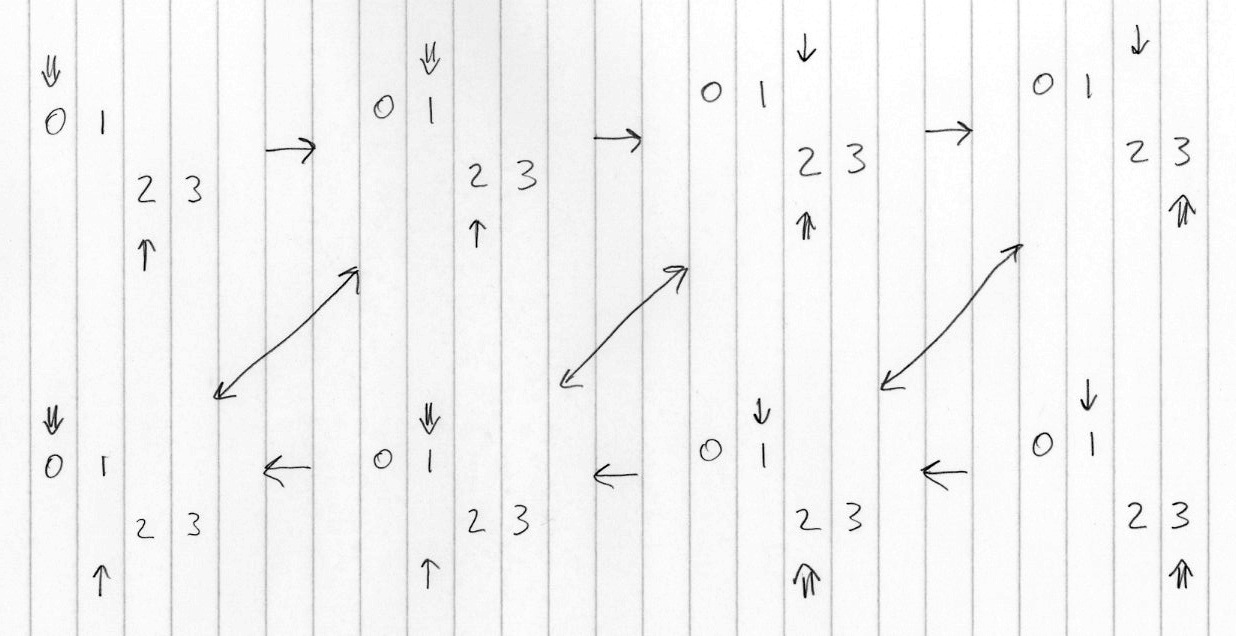
The last problem I ran into was a tricky one. In order to defer btree updates till commit, I use transaction local btrees. Which means to access an index you have to look at both the local and the global btrees. To do this I use an iterator that merges two other iterators. Iterating through two sorted sequences in parallel is a standard easy problem. But Suneido allows you to bidirectionally step forwards or backwards in any order with the same iterator. And it turns out that this makes iterating in parallel a lot tougher. The trick is when you change directions. The final code is not that large (look at next and prev in MergeIndexIter) but I went through about six different versions before I finally got one that appears to work. Of course, most of my previous versions also appeared to work, until I added more test cases.

A big part of finally figuring this out was coming up with the right visualization for it. Here's what I ended up with:


Notice it's paper and pencil. (It should have been on graph paper but I so seldom do stuff on paper anymore that I didn't have any handy.) I would have preferred to do it digital, but I couldn't think of an easy way to do it. I could have done it in a drawing program or even a spreadsheet or word processor, but it would have been a hassle. Drawing programs make it possible to do just about anything, but they'd don't tend to make it easy and natural (at least, if you only use them occasionally like me). Maybe there's a market niche for someone to go after. Or maybe there already is a good program for doing this - anyone know one?

Given the extra complexity, I started to question whether Suneido needed to allow you to switch directions with an iterator. I can only think of a couple of places where we use this. But I'll leave that question for another day.

And now back to testing. I imagine I've still got a few bugs lurking in there. I also need to do some testing and see whether I've actually solved the database growth problem. It may be harder to know whether the transaction issue is solved until we actually get it in production.

Friday, March 23, 2012

I'm a little slow sometimes

A roundabout detour of bit twiddling optimizations that turn out to be ultimately unnecessary.

Originally, Suneido used 32 bit database file offsets. Remember when disks (let alone files) were limited to 4 gb? When we needed to support databases larger than 4 gb, I didn't want to switch to 64 bit offsets because of the extra space required to store them, so I "compressed" larger offsets into 32 bits. (a bit like the Java -XX:+UseCompressedOops option)

The approach I used was to align and shift. If you align the data in the file on, for example, 8 byte boundaries, then the lower 3 bits of an offset will always be zero. So you can shift a 35 bit offset to the right 3 bits so it fits into 32 bits. (Who says bit twiddling is dead?) This allows a maximum file size of 32 gb instead of 4 gb. (Actually, for obscure historical reasons, even though the alignment is 8 bytes, the shift is only 2 bits, so the maximum size is 16 gb.)

The tradeoff is some wasted space. Each block of data will waste an average of 4 bytes.

The problem is, it's starting to look like we need to allow even larger databases. I could just increase the align/shift to 16 bytes/4 bits to allow 64 gb. But that would increase the average waste to 8 bytes, even though most databases aren't that big.

Ideally, you'd want small databases to use a small align/shift, and larger databases to use a larger align/shift. I could make the align/shift a command line option, but you'd have to rebuild the database to change it. And I'm not a big fan of cryptic options that most people won't understand.

My next thought was to use a variable align/shift. There are different ways you could do this, but a simple one would be to reserve two bits to specify the align/shift. This would leave 30 bits (1 gb range) for the unshifted offset. For example:

00 = 4 byte alignment = 0 to 4 gb
01 = 8 byte alignment = 4 to 12 gb
10 = 16 byte alignment = 12 to 28 gb
11 = 32 byte alignment = 28 to 50 gb

For databases up to 4 gb, this would use a smaller alignment than currently and therefore less wasted space, while still allow a much higher maximum size than now. Only large databases would pay the cost of higher wastage due to larger alignment.

This scheme would be slightly more complex to decode, but not too bad.

At first I was excited about this approach, but it doesn't scale. You can increase alignment to allow bigger files, but then you waste more and more space. At some point, you'd be further ahead to drop the alignment and just store 64 bit offsets. Except you don't want the overhead of large offsets on small databases.

So why not just use a variable length encoding like Google Protocol Buffer varint?

A variable length encoding would not be the simplest thing to manipulate in the code, but we don't have large numbers of offsets in memory, so you could use 64 bit unencoded offsets in memory, and just use the variable length encoding on disk.

At this point I whack myself on the forehead. D'oh! Sometimes I am such an idiot! (A lot of my "aha!" moments are spoiled by thinking that if I was just a little bit smarter and had thought of it a little sooner, I could have saved myself a lot of work.)

Suneido already uses a variable length encoding when storing file offsets!

The offsets are stored in the btree key records. They are getting encoded the same way other numeric values are packed into records, which is a already a variable length encoding.

So all the messing around with align/shift is mostly wasted effort. It does reduce the magnitude of the offsets, which does mean they are encoded slightly smaller, but this is minor.

I'd be further ahead to drop the align/shift altogether, use 64 bit offsets in memory, and let the variable length encoding handle making small offsets small. This would eliminate the whole maximum database file size issue!

If I want to save space, I could use a different variable length encoding for offsets. The current encoding is designed for Suneido's decimal floating point numbers and is not ideal for simple integers.

I can't use the Protocol Buffer varint encoding because I need encoded integers to sort in the same order as the original values. varint's don't because they are stored least significant first. One simple approach would be to reserve the first two bits to specify the length of the value, for example:

00 = 4 bytes
01 = 5 bytes
10 = 6 bytes
11 = 7 bytes

This would give a maximum of 54 bits (7 * 8 - 2) or about 16,000 terabytes. By the time anyone is trying to make a Suneido database bigger than that, it should be someone else's problem :-)

Of course, I'm itching to implement this, but I'm in the middle of debugging my immudb improvements so it'll have to wait.

Monday, March 05, 2012

Piracy?

I've been a fan of Pragmatic Programmers and their books for a long time. I buy their books directly, both to maximize their revenue, and to get eBooks without DRM.

Recently I noticed this at the bottom of one of my order emails. (I'm not sure how long they've been including it.)
Please don't put these eBooks on the 'net or on file-sharing networks. Sometimes folks do this accidentally by downloading into a shared directory.
I don't have any problem with the "don't post these eBooks on the 'net" part. But I really question the file-sharing part - not the legality of it, since I'm no expert on that, but the "morality" of it. Even the 'net part needs to be more specific - I put my books on the "net" - into Dropbox so I can access them from various devices and locations, but they're not public. Of course, maybe that's not "legal" either.

If I bought a paper copy of the book, and put it on the bookshelf in our company coffee room, I don't think I'd be breaking any laws. But I'm not supposed to do the same thing with a digital copy.

Potentially, multiple people could simultaneously read the digital copy. But I have trouble getting anyone to read any books. The chances of multiple people reading the same book at the same time is slim to nil.

Note: If my staff needs regular access to a book, I have no problem with buying extra copies.

I always thought Prag Prog were more "enlightened" than this. But obviously someone there couldn't resist the urge to "wag their finger" at us.

In some ways, Amazon, despite their DRM, is more flexible. I could buy Kindle books on a company account, and set up multiple Kindle readers (either devices or software) associated with that account. I don't know if Amazon would regard that as entirely legitimate, but they allow it. (Albeit, intended for "families".)

Publishers want to have their cake and eat it too - they want the benefits of digital - no printing, no inventory, no shipping, and at the same time, they want to take away all the traditional rights we had with paper books to share and lend. Some eBooks are now more expensive than the hardcover - what's the story with that? Who are the pirates now?

Sunday, March 04, 2012

jSuneido Immudb Progress

I've made good progress on the changes to the append-only database storage engine for jSuneido. The new version now passes all the built-in tests, although I have a few things left to do to improve performance.

I'm pretty happy with how it went. No big surprises and the code turned out quite simple for the most part. It's nice that there's less shared mutable state and therefore less potential locking issues.

Previously, updating the shared state and persisting to disk were a combined process. It was a little tricky teasing this apart so they were independent. For example, the semi-immutable data structures were flipping to immutable when they were stored. Now they have to be flipped to immutable before they go into the shared state, separately from being stored.

Of course, the reason I did all these changes was to try to address some "production scale" issues, and I still haven't got to the point where I can really tell if I've solved them or not. So far, the signs are good.

As usual, the code is in Mercurial on SourceForge

Related: Immudb Progress

Sunday, February 19, 2012

Immudb Progress

I've been plugging away at improvements to the immudb append-only storage engine for jSuneido.

To reduce database growth: (see Houston, we have a problem and Problem or Opportunity?)

- Change to persist btree index changes to disks periodically, instead of after every transaction.
- This makes redirection less important so I'm removing it. (Funny how this great idea is suddenly more trouble than it's worth.)
- This also allows persisting btrees in a separate concurrent thread. To make this as independent as possible I plan to split the database into two files. I have mixed feelings about this because I really like having everything in one file. With two files you have to make sure you always backup / restore / copy / move / rename the two files together because if they get out of sync you're in trouble.

To reduce transaction conflicts: (see Suneido Database Transaction Puzzle)

- Instead of tracking reads and writes by btree node, track writes by record and reads by index range and predicate.
- This makes it harder to use the previous approach of merging btree versions. Instead I'm "overlaying" transaction local indexes over the "master" indexes, and then applying the index changes to the master index during commit. (Easy because commits are single-threaded.)


None of these changes is that big, but unfortunately, they are fairly invasive. Rather than "break" everything while the changes are in progress I've been taking a "strangler fig" approach, keeping the existing code intact and functional while at the same time building up a new version that leans heavily on the old one. Once I have the new version functional on its own I can remove the vestiges of the old code.

I should probably be doing these two sets of changes separately, but they keep getting mixed together in my head. I just know where I want to get to, not necessarily which problem each particular change is aimed at. The changes all affect the same code, so in some respects it's easier to do them together. Time will tell whether this was the right approach :-)

Another question is whether the changes I'm working on will actually succeed in reducing database growth sufficiently. I'm actually fairly confident about this because it's not a "yes or no" question. If you persist the indexes after every commit you get the excessive growth I've already seen. At the opposite extreme, if you only persisted at shutdown, you'd get minimal growth. Presumably, the answer lies somewhere between these two extremes. Looking at it another way, if you updated the same btree node in each transaction, if you only saved it once per 10 transactions, then you'd get 1/10th the database growth. If 1/10th is still too big, then you only save every 100 transactions, giving 1/100th the database growth. Since the actual data is still being written to disk at each commit, the only cost of persisting the indexes less often is increased work by crash recovery, which (a) shouldn't happen that often, and (b) processing e.g. 100 commits worth of data to recover from a crash doesn't seem that bad.

Another nice feature of deferring persisting indexes is that it offloads work from commits which are a potential bottleneck since they're single-threaded. There are some issues with persisting indexes concurrently with commits, but I think I have an approach figured out. On the other hand, I'm now updating the master indexes during the commit so it's not all gain.

So far so good. I have some of the pieces working and it's gradually coming together. I'm anxious to see how it turns out.